Author’s Gab, Reader Talk.
A letter to you, the reader, so that you can finally figure out what I’m thinking.
—————————————
This Month: Staying sane with sestinas
————————————————–
Dear Reader,
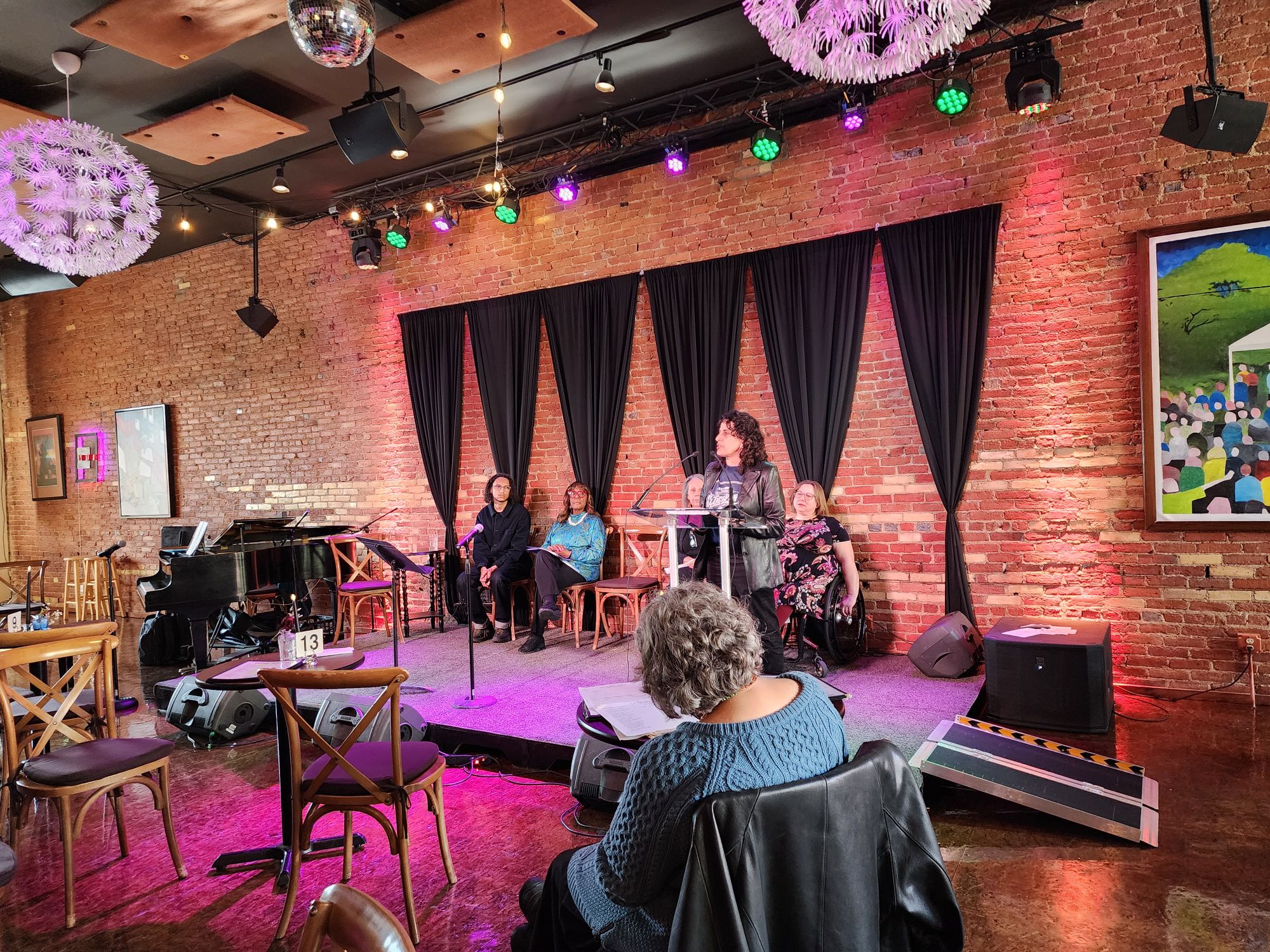
While thinking about the daunting task of writing sestinas again lately, I found myself saying something interesting to Lansing poet lauterate Ruelaine Stokes at the event we were both attending, “Pzazz… an afternoon of poetry & jazz” at UrbanBeat in Lansing on Mothers Day 2026, “It’s not the form that’s the problem, because anyone can just use any six words and complete the poem,” I said. “It’s getting the point across inside the form that’s the issue.” I said this because, each time I write a sestina, it takes so much out of me. When I get done, I usually go, “Whoa, I didn’t know I had that much to give,” and “Ugh, I don’t think I can write another word right now! I have to write another one of these?” Shorter poetry is easier to write for me, because I can focus on the one sentiment I want to write about and spit it out quickly. But, sestinas go around in circles and get mixed up like a washing machine, and I find myself all confused by the time I get done. So, in the spirit of wanting write 10 of these minimum, I thought I would do a brief focus on the form, for your sanity and mine.
I’ll start with the sample I have been meditating on for years, “I Dreamed I Wrote This Sestina In My Maidenform Bra” by Denise Duhamel:
"I Dreamed I Wrote This Sestina in My Maidenform Bra"

In the 30s, A-cup breasts were called nubbins,
B-cups snubbins,
C-cups droopers, and D-cups super droopers.
In the 50s, a bullet bra could make a bombshell
of most women. Pointy torpedo cups
had every Hollywood starlet hooked.

But Tinkerbell was only a 32-A, flitting past Captain Hook,
Peter Pan admiring her nubbins
as he cupped
her in his hands and snubbed
adulthood. When he dropped a bombshell—
that he wanted to be a boy forever—she drooped

in his palm, wishing for a padded bra, her eyes drooping
too.
Snow White was a respectable 36-B, just enough to hook
the prince without being tawdry. Snow was a bombshell,
though, to the dwarves, little nubbins
of men she snubbed
without meaning to, filling their tiny cups

with grape juice instead of wine. A couple
of times she even mixed up their names.
Cinderella drooped
until her fairy godmother found her the right bra. Snubbing
her flat-chested stepsisters, Cinderella hooked
herself into one sturdy 38-C underwire and two luscious nubs
emerged through her ragged blouse. The bombshell

of the ball, she was afraid to drop a bombshell
on Prince Charming, that she’d be cupping
well water and cleaning cinders by morning, nubbins
of pollen and feathers stuck in the straw of her droopy
broom.
Sleeping Beauty almost looked like a hooker
with those 40-D knockers which seemed to snub

the Evil Queen’s saggy cleavage. When the Queen’s mirror snubbed
her in favor of the younger “fairest of them all” bombshell,
Evil cast her spell and Sleeping Beauty was off the hook
(at least when it came to housework). She lazed around, her cupped
hands solemn across her waist. All the tulips drooped
towards her to whisper into the pink nubbins

of her ears: Never snub your dreams, drink from the cup
of your bombshelled unconscious, where para-droopers
unhook nubbins of meaning as you snooze in your Maidenform Bra.
For those who don’t know, a sestina is composed of six end words that repeat throughout the poem in six rounds in a specific order. This concludes with one ending paragraph, where all the end words are repeated for one last time in half lines, also in a specific order. The above poem is what we would consider a classically formed sestina. So, as I said initially, the form is not the issue here.
The issue is that this is a wonderfully formed commentary on women in the twentieth century. Under the guise of talking about the entire issue through a dream about bras and Disney princesses, Duhamel tackles the issue of how women were treated or identified themselves socially and physically. So, the poem isn’t what it appears to be on the surface; instead, it takes us deeper. So, how do we do that? This is the question I have been asking myself and pose to you today. How do we get the story across in this longer form like Duhamel without getting lost in it?
Unfortunately, I do not find Duhamel a great example to go on when it comes to composition. As I said, I tend to get lost in her poem trying to find my own. So, for composition, I will have to turn to “The Painter”, by John Ashbury:
"The Painter"

Sitting between the sea and the buildings
He enjoyed painting the sea's portrait.
But just as children imagine a prayer
Is merely silence, he expected his subject
To rush up the sand, and, seizing a brush,
Plaster its own portrait on the canvas.

So there was never anypaint on his canvas
Until the people who lived in the buildings
Put him to work: "Try using the brush
As a means to an end. Select, for a portrait,
Something less angry and large, and more subject
To a painter's moods, or, perhaps, to a prayer."

How could he explain to them his prayer
That nature, not art, might usurp the canvas?
He chose his wife for anew subject,
Making her vast, like ruined buildings,
As if, forgetting itself, the portrait
Had expressed itself without a brush.

Slightly encouraged, he dipped his brush
In the sea, murmuring a heartfelt prayer:
"My soul, when I paint this next portrait
Let it be you who wrecks the canvas."
The news spread like wildfire through the buildings:
He had gone back to the sea for his subject.

Imagine a painter crucified by his subject!
Too exhausted even to lift his brush,
He provoked some artists leaning from the buildings
To malicious mirth: "We haven't a prayer
Now, of putting ourselves on canvas,
Or getting the sea to sit for a portrait!"

Others declared it a self-portrait.
Finally all indications of a subject
Began to fade, leaving the canvas
Perfectly white. He put down the brush.
At once a howl, that was also a prayer,
Arose from the overcrowded buildings.

They tossed him, the portrait, from the tallest of the
buildings;
And the sea devoured the canvas and the brush
As if his subject had decided to remain a prayer.
You can really see the form here in its conventional sense, while also seeing the story Ashbury is telling. We go from a guy who is trying to paint the sea to a guy who is rejected, not only by society, but by his painting itself. You can really see the power words have on this painter, who ends up at the bottom of the barrel by the end of his poem. Ashbury takes the painter and does something with that painter and the portrait he’s painting. That’s the story he’s trying to get across here. And, that’s how composition expresses itself within this form, throwing the point of his rejection in your face again and again with the repetition of the end words.
However, I actually want to pry this open further with a look at Julia Alvarez’s “On Sundays”. We don’t have a form here, but we have some amazing composition we can apply to our sestinas. I was on a road trip to Kentucky with my parents, and I had brought my Poets and Writers May/June issue along with me. I thought it would be fun to read some poetry with my folks while riding along in the backseat; and, I quickly found this poem in their feature, “The Wildness and the Mystery: A Profile of Julia Alvarez” by Renée H. Shea:
"On Sundays"
by Julia Alvarez

On Sundays we would get to choose
whom we belonged to, the choice disguised
as destination: either cathedral mass
with Mami or the beach with Papi,
a simple choice, were it not we knew
how on a whim he'd change his mind
en route, as we whined he'd tricked us,
leaving us waiting in the airless Chevy,
just a minute, the backseat burning
in the tropic heat of what would soon
be midday, while he made his rounds
at the hospital, or turned down a wash-
board road that hurt our bottoms to fill
the trunk with river stones that took hours
to pick—just the right size, the right shape,
for the fishpond he was building, which
required a stop at the almacén, just around
the corner, for cement—errands he omitted
mentioning when he promised white sands,
pounding surf, coco water dripping down
our chins and swimsuits—as if to teach us
that no place would ever be the place
we meant to get to, what we hungered for,
the way the sea was hungry, its ragged mouths
opening for boats, toys, kids—spitting them back
as driftwood, shell shards, tiny skeletons;
or coming after us, as we raced up the beach,
never knowing what it wanted from us,
which might be why I chose it every time;
why now in my troubled turnings, when I
make no sense or headway, I see
how I trained for this, how each time
I knew from the last time
those beaches were unlikely, knew
what I was missing, how after mass,
Mami would drive to Capri's,
with its candycane-striped awning, its blast
of cold air like winter not yet known
first hand, the cartons of imported ices,
ice cream under sliding glass doors, deliberations
back and forth, or peppermint, or plain
vanilla, topped with chocolate sauce,
or sprinkled with confetti colors, honing
the skill of choosing predictable outcomes.
Instead I practiced patience in the face of
disappointments, sharp reversals, for
the rare, rewarded hope, when he took
that final curve almost into the sky—
and it lay before us: vast and blue, roaring
in the distance, spired with whitecaps, belled
with buoys, and in the rearview mirror,
his face, like mine, awash with waves
of joy, as I leaned forward,
as if to whisper in his ear, I'm yours,
the way it sometimes happens: we arrive
where we were promised, belong to
what we longed for in ourselves, each other.
My folks are math/science people. My dad, now retired, was an upper body structures engineer at General Motors for over thirty years, while my mom was a nurse who dabbled in education, herself just retired from teaching nursing program labs at Eastern Michigan University. I had asked them if they read, much knowing the answer. My dad does, while I would be lucky to catch my mom reading a magazine every once and a while. And so, it took a couple rounds of reading the poem to them before my mom exclaimed, “You know, I have never been a person who was good with words. I have no idea how my daughter is one of them!” And, we laughed, of course, as I answered, “Yeah, that stuff has always been easy for me.”
But, in reading “On Sundays” back and forth to them, I realized I got something new out of it each time I read it. Like, the poem was a well and there was more to draw from it if you were thirsty enough to get it all out. Not only does it chronicle the options of hanging out with either parent in detail and what the choice entails, it begs to to wonder where you belong in all that, in your world. Maybe you had divorced parents where you had to chose which to spend a Sunday with, and that really defined who you were and who you belonged with on that specific Sunday. Or, maybe it was simpler than that and your parents stayed together like mine and it was just a matter of who was taking the kids out on Sunday afternoon and what you were doing with the parent that was taking you. Did you arrive at where you belong like the author, in either case? Or, was there a sense of loneliness and like maybe you belonged somewhere else?
It goes to show that good composition doesn’t need a form to draw you in. It speaks for itself. And so, when we think about writing sestinas, it’s really how we utilize the form that’s already there to get the point across that matters. It can be multilayered like Duhamel or it can be more straightforward and conventional like Ashbury, as long as it reaches the depth and leaves the reader with the bag like Alvarez at the end of the poem, or sestina, in this case.
So, what’s “the bag”? That’s the bane of longer form poetry like sestinas, is you almost have to know where you’re going when you start, or the poem is going to get lost halfway through. Stokes, I noted, is famous for her narrative poetry, which I really have enjoyed listening to at the events I have been a part of. I certainly didn’t know who I was meeting, but she gave me some good advice when I asked about her longer form poetry composition, “Make an outline,” she said.
She’s not wrong. In the sestinas I have already written (callously locked away behind closed doors out of respect for my mother’s wishes, as they are both about her and her side of the family, as they are), I have created outlines. Particularly on my sestina, “(From) where you draw your strength”, I had to incessantly outline that thing to get my point across. What’s the point? Where is it going? Even with the outline, it was like groping my way through the dark until it was finished. But, looking at it, I’m proud now of what I did. And so, as I began outlining a different sestina in my head on the car ride home from “Pzazz”, I realized “the bag” as I had conceived it would probably be expressed differently than maybe I had imagined it.
Another way to think about it is that you would never write a book without making an outline or table of contents. You’re probably going to do a heck of a lot of concepting and research first, but then you’re going to draft an outline for your final composition. The same goes for longer form poetry. If you’re going to write a narrative, best to know where it’s headed first.
So, in conclusion, don’t overthink it. Don’t get hung up on the form. As Lyric Lab Poetry says in this YouTube video, try focusing on one word like “water”, centering the end words around that and then figuring out what you want to say about it. At the “Pzazz” event, they started an improv on the piano with the word “feelings” and went from there, asking each audience member to riff on it. So, riff on your word or topic and see what you’ve got. I’ll try to do the same, and maybe this whole sestina thing won’t feel so insane or daunting, after all.
Think about that. ~
Sincerely, Your Writer,
Jessica A. McLean
…………………………………………………………………………………………………………………………………………..
Recent Happenings:
- Recent Ad-Lib Activity:
- The May 2026 Ad Lib is here!
- TBA: I’m working on finishing my series on form. Stay tuned.
- The May 2026 Ad Lib is here!
- Recently Published:
- Poems Added:
- “How to write an etheree”, a sample etheree on the form
- Poems Added:
- Editing, editing, and more editing.
- Waiting
……………………………………………………………………………………………………..