
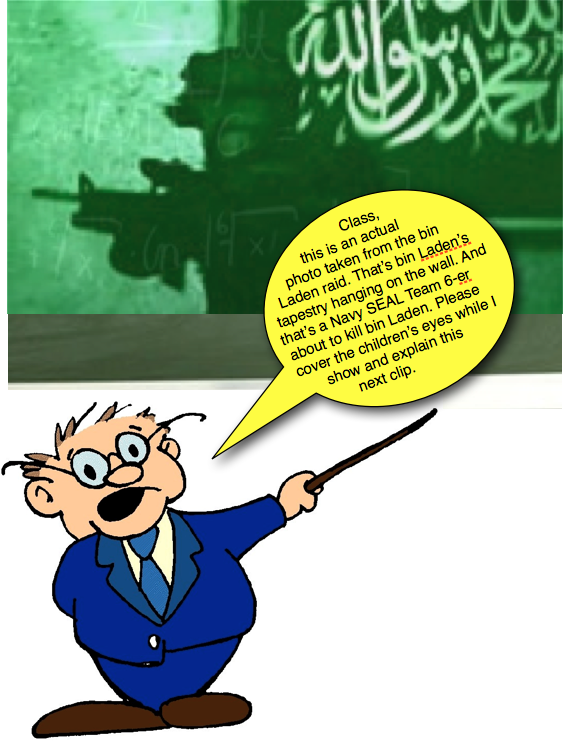
A joke is only bad when you have to explain it. Nobody laughs. In fact, they may even make jokes about your bad joke. It’s just plain embarrassing. It’s a lot like getting caught with one of those “X for Dummies” books in your hands: no one wants to admit they have one, but they’re really popular because people actually do need them. I researched and wrote my poem “The Milliseconds” for an educated reader, who knew the story of bin Laden’s death in detail and any applicable, surrounding events regarding the situation. This amount of detail required me to conduct extensive research on the topic, and over a month of careful consideration, before I finally published the final product. But, lately, and unsurprisingly, my uneducated, average readers aren’t laughing at my “joke” . They furrow their brows in confusion and come up with the wrong answer or just politely ask for a brief explanation before they read the poem. Consequentially, it seems to me that my average readers are indiscreetly telling me that I have told a bad joke, and that I must explain myself. On the other hand, my educated reader hasn’t submitted a complaint. Thus, I offer you “dummies” out there a blow-by- blow guide to my poem “The Milliseconds”, so you may enjoy reading it as much as it tickled me to write it. 🙂
Let’s start with the poem’s form. An etheree is a relatively new form of poetry designed to grow or to explain an idea, like the ironic connection between soldier and enemy so adeptly expressed in the milliseconds of bin Laden’s death. An etheree is meant to evolve and expand this idea, or to summarize it, depending on which way its formed: 1 syllable (first line) to 10 syllables (last line) or 10 syllables (first line) to 1 syllable (last line). Basically, it’s designed to take something small and make it bigger, or something big and make it smaller. I originally did not settle on this form, but instead favored the semi-perfect sonnet. But, when I realized exactly how much of an etheree (small to big) this poem really was, I quickly changed my mind.
Ok, on to the first and second lines. The poem begins with the word “aim”, describing not only the incredible planning and preparation that went into this event but the actual act of the Navy SEAL Team 6-er reacting. Imagine for a moment, if you will, complete blackness. It’s about 1 a.m. local time at Osama bin Laden’s Compound, the Waziristan Haveli/Waziristan Mansion, in Abbottabad, Pakistan, and our SEAL, Mark Owen, doesn’t have any night vision goggles, even though his helmet bears a camera (so the President can watch the action). He bursts through the door into bin Laden’s bedchamber and bin Laden’s wife makes a threatening move. He has seconds to take aim and react, but you are talking about the best here. This is household business for this SEAL. So, he does what he’s trained to do. His collaege shoots the wife in the leg while he takes aim at bin Laden (this is all happening very quickly). He instinctively touches the trigger and pulls it, giving us our second line: “touch, pull”. It could be said that this is a fancy way of saying “aim, fire!”
The third and fourth lines explain what happens next: the Navy SEAL Team 6-er’s H&K 416 assault, gas machine gun fires the bullet. If you study machine guns, you will likely realize that as long as that trigger is held down, the gun will fire, providing you have enough ammo. As soon as the bolt is released by the trigger, it hits the bullet, igniting its outer coating and exploding the gunpowder, which sends it forward. The bullet passes through the barrel and the silencer, exiting the gun and making a thud as the gasses expand and dissapate inside the silencer (another reference to my “expanding” theme). I tried to sum this process up in the second and third lines when I said: “igniting/ releasing thud”.
The 5th, and sometimes 4th or 6th, lines of an etheree should always, always be your pivotal transition point. It’s the half-way point: 5 syllables. From here on in, the reader and writer will be asked to resolve the poem, with anything before it considered set up for this moment. Therefore, in the 5th (and 6th) line (s), I present to you the meat of my argument: “kinetically,/invisibly bolting”. The comma is present because I want you to pause here, but I also want you to connect these two lines and sense the flow of the bullet flying through the air. Thus, if you paid attention in physics class, you should realize the raw kinetic energy of these lines: they move the bullet through the air at an invisible speed and simultaneously move the poem forward.
So, why would I bother to waste these lines on raw energy? Answer: time. This poem is moving… forward. The whole thing is just kinetic (and potential) energy. Just like time marches steadily forward, just like the milliseconds become seconds, the seconds become minutes, the minutes become hours, the hours become days, the days become years, and the years become decades (and so on), this poem accumulates with time. Think of a blizzard, how the snow accumulates- like that. So, I’m letting you know this situation is moving. As it moves, it “invisibly bolts” these two individuals together, expressing the ironic relationship between them, let alone (the irony of) bin Laden’s terror. I invite the reader to just hang on that line for a moment in time, even as I discreetly reiterate just exactly how fast this bullet is moving.
As we move to the seventh line, the poem must resolve itself. Sadly, I have to kill bin Laden- the SEAL’s aim is that good! I wanted to capture the moment that bullet first touched his skin and where it was located, and finish with it embedding itself in his head. By saying, “begins above left eye brains”, I’m giving you all the juicy details about his death, including the fact that he died. But, the bullet doesn’t stop there. It continues through his head, exiting his skull and implanting itself into the wall behind him. His head bleeds. He begins to fall.
But, remember that M4? I tried to use “-ing” verbs to refer to the M4, like I used the word “bolting” back in line 6. I was foreshadowing what would inevitably come in line 9: the firing of the second bullet. You must understand that bin Laden was shot twice: first in the head, above the left eye, and then in the chest. It felt significant to me: one shot to the head and one shot to the heart, to secure his death. This bullet also went strait through him into the wall behind him. The impact could have very well shattered his ribs or spine before it passed through him and joined the first bullet in the wall. Line 9, thus, gives finality to bin Laden’s death: “two chest clinch (meaning “secure”) pass shatter joining stop”. Notice how I use the word “joining” before the word “stop”. I’m referring back to those M4s again, and I have successfully, in two words, ceased all fire from the SEALs.
In the tenth line, I give you the split second and elongated aftermath of the situation. In a split second, the SEALs realize what’s occurred. In hours, the public realizes what’s happened. The SEALs confiscate the body and bury it at sea (notice the word “fathom”). The message to President Obama (regarding the mission, code- named Operation Neptune Spear) is a successful one, “Geronimo-E K.I.A.”, meaning: “Osama bin Laden killed in action”. Thus, I conclude by leaving this poem open ended, because it expanded into something incredibly significant after the event. Line 10 concludes “fathom Geronimo-E K.I.A.” without a period, implying that the situation, like time, will continue. The death is final, but the story goes on and continues to expand. It’s sort of prophetic, really.
Ok, bad joke over. You are free to make jabs at me now, which may or may not be funnier. Nevertheless, like Sparknotes or “X for Dummies”, I hope this explains my poem “The Milliseconds” more in detail, eliminating your, my average reader’s, confusion. Now that you have the study guide, however, I encourage you to read my poem over one more time after you read this blurb, just to absorb its meaning. After all, you are now the educated reader I intended, so have at it. Perhaps, in the end, this explanation will allow you to relish it, “laugh” a little, even as much as I loved writing the poem itself. 🙂
This essay is Copyright 2011 of Jessica Anne McLean; all rights reserved. File Sharing is encouraged.





 The Rose