
AUTHOR’S GAB, READER TALK.
A LETTER TO YOU, THE READER, SO THAT YOU CAN FINALLY FIGURE OUT WHAT I’M THINKING.
—————————————
THIS MONTH: The Prose Poem
————————————————–
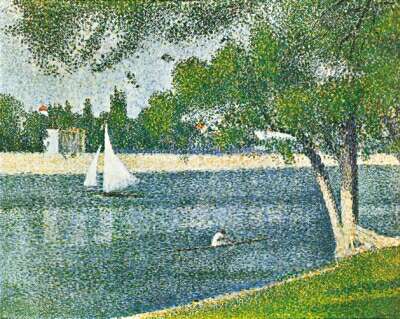
painting by Georges Saurat, impressionist and classic pointillist
Dear Reader,
Lately, I’ve found myself writing a lot of prose poems, mostly because they’re easy. I can just say what I’m thinking or feeling at the moment, straight up, and I don’t have to worry about taking the trouble to format anything. They are just snippets, moments of profound thought I had at this moment or another, each speaking a unique truth. Essentially, as Poets.org says, “though the name of the form may appear to be a contradiction, the prose poem essentially appears as prose, but reads like poetry.”
For instance, “Healing My Broken Heart”, the featured poem for this month, speaks to an experience I had back when I was dating my ex-boyfriend. I was hurting, with a broken heart, coming off of a bad relationship and in terrible need of emotional healing. I got that healing in a moment of passion, fluid consciousness, making out with the man I loved in the hotel lobby that night. It created a sense of wholeness in me which, bringing me closer to God, has been instrumental in my life ever since.
So, this month, I think I would simply like to explore what a prose poem is and what it means.
To start, let’s examine some history. There is a lot of debate on exactly when prose poetry actually became, well, prose poetry. This is because, as I previously stated, prose poetry can be an oxymoron. People just can’t decide if it’s just really short prose or just really “bad” poetry.
So, as Kevin Brophy, Head of Creative Writing at the University of Melbourne, states in his paper, “The Prose Poem: A Short History, a Brief Reflection and a Dose of the Real Thing”, even though prose poetry was officially introduced as a poetic form in France by the poet Charles Bauledaire in 1861, it took until 1890 for the English to actually take an interest in it, write it and spread it around.
Oscar Wilde, Brophy said, was the first English writer to take up the task, with his “Poems in Prose” (1894), “a suite of six prose poems, mostly composed in an ironic and decorative biblical style replete with anaphora and the artificiality of thee’s, thy’s and thou’s. Each poem was a small portrait contained in a narrative which obliquely offered a philosophical observation.”
After this, prose poetry, as far as the tradition of English (and American) literature is concerned, seems to take a back seat; although, it did continue to play in important role in French literature. Even today, when it’s intrigue is more prevalent, it seems more preferred as a secondary poetic form, full of philosophical whims and contradictions.
For example, Campbell McGrath, an American poet and a master of the free verse and long poem, seems to capture this mixed emotion in “The Prose Poem”, a prose poem, well, about a prose poem:
On the map it is precise and rectilinear as a chessboard, though driving past you would hardly notice it, this boundary line or ragged margin, a shallow swale that cups a simple trickle of water, less rill than rivulet, more gully than dell, a tangled ditch grown up throughout with a fearsome assortment of wildflowers and bracken. There is no fence, though here and there a weathered post asserts a former claim, strands of fallen wire taken by the dust. To the left a cornfield carries into the distance, dips and rises to the blue sky, a rolling plain of green and healthy plants aligned in close order, row upon row upon row. To the right, a field of wheat, a field of hay, young grasses breaking the soil, filling their allotted land with the rich, slow-waving spectacle of their grain. As for the farmers, they are, for the most part, indistinguishable: here the tractor is red, there yellow; here a pair of dirty hands, there a pair of dirty hands. They are cultivators of the soil. They grow crops by pattern, by acre, by foresight, by habit. What corn is to one, wheat is to the other, and though to some eyes the similarities outweigh the differences it would be as unthinkable for the second to commence planting corn as for the first to switch over to wheat. What happens in the gully between them is no concern of theirs, they say, so long as the plough stays out, the weeds stay in the ditch where they belong, though anyone would notice the wind-sewn cornstalks poking up their shaggy ears like young lovers run off into the bushes, and the kinship of these wild grasses with those the farmer cultivates is too obvious to mention, sage and dun-colored stalks hanging their noble heads, hoarding exotic burrs and seeds, and yet it is neither corn nor wheat that truly flourishes there, nor some jackalopian hybrid of the two. What grows in that place is possessed of a beauty all its own, ramshackle and unexpected, even in winter, when the wind hangs icicles from the skeletons of briars and small tracks cross the snow in search of forgotten grain; in the spring the little trickle of water swells to welcome frogs and minnows, a muskrat, a family of turtles, nesting doves in the verdant grass; in summer it is a thoroughfare for raccoons and opossums, field mice, swallows and black birds, migrating egrets, a passing fox; in autumn the geese avoid its abundance, seeking out windrows of toppled stalks, fatter grain more quickly discerned, more easily digested. Of those that travel the local road, few pay that fertile hollow any mind, even those with an eye for what blossoms, vetch and timothy, early forsythia, the fatted calf in the fallow field, the rabbit running for cover, the hawk’s descent from the lightning-struck tree. You’ve passed this way yourself many times, and can tell me, if you would, do the formal fields end where the valley begins, or does everything that surrounds us emerge from its embrace?
Consequentially, when one reads a prose poem, the reader should ask: what sort of philosophy, stream of consciousness, unique truth or contradiction is the writer trying to communicate here? And, certainly, the answer will be different for each one. It’s an acknowledgement of, a call for, pragmatism in the search for the objective truth.
That leaves a high degree of error for interpretation of this kind of “surrealist” poetry. What the author intended may or may not be the meaning you come out with. And, the ironic part is: that’s ok.
Think of it like a surrealist or impressionist painting, where everything is fluid but nothing is clear. Charles Simic, an American surrealist-inspired poet, popularly sums it up this way in his essay, “The Poetry Village Idiots” (1996):
Writing a prose poem is a bit like trying to catch a fly in a dark room. The fly probably isn’t even there, the fly is inside your head; still, you keep tripping over and bumping into things while in hot pursuit. The prose poem is a burst of language following a collision with a large piece of furniture. (7)
So, this month, when you have a fluid thought, like I did when I wrote “Healing”, read (or write) a prose poem. In a communitarianism sense, it becomes a larger part of the whole, which, in essence, is what makes prose poetry so awesome and beautiful.
This month, think about that. 😉
Sincerely, Your Author,
Jessica Anne McLean
………………………………………………………………………………………………
Works Cited:
Brophy, Kevin. The Prose Poem: A Short History, a Brief Reflection and a Dose of the Real Thing. Melbourne, Australia: University of Melbourne, 1 Apr. 2002. PDF.
“Campbell McGrath.” The Poetry Foundation. Poetry Foundation, n.d. Web. 15 July 2013. <http://www.poetryfoundation.org/bio/campbell-mcgrath>.
“Charles Baudelaire Biography.” Bio.com. A&E Networks Television, n.d. Web. 15 July 2013. <http://www.biography.com/people/charles-baudelaire-39436?page=2>.
“Charles Baudelaire (French Author) : Les Fleurs Du Mal.” Encyclopedia Britannica Online. Encyclopedia Britannica, n.d. Web. 15 July 2013. <http://www.britannica.com/EBchecked/topic/56335/Charles-Baudelaire/643/Les-Fleurs-du-mal>.
McGrath, Campbell. “The Prose Poem.” Poets.org. Academy of American Poets, 2003. Web. 15 July 2013. <http://www.poets.org/viewmedia.php/prmMID/16561>.
“Poetry Previews: What’s a Prose Poem?” Poetry Previews: What’s a Prose Poem? N.p., n.d. Web. 15 July 2013. <http://www.poetrypreviews.com/poets/prosepoem.html>.
“Poetry vs Prose.” – Difference and Comparison. N.p., n.d. Web. 15 July 2013. <http://www.diffen.com/difference/Poetry_vs_Prose>.
“Professor Kevin Brophy.” School of Culture and Communication. University of Melbourne, n.d. Web. 15 July 2013. <http://culture-communication.unimelb.edu.au/about/people/academic/kevin-brophy>.
Wilde, Oscar. “Poems in Prose.” Oscar Wilde Online. N.p., n.d. Web. 15 July 2013. <http://www.wilde-online.info/poems-in-prose.html>.




 The Rose