
AUTHOR’S GAB, READER TALK.
A LETTER TO YOU, THE READER, SO THAT YOU CAN FINALLY FIGURE OUT WHAT I’M THINKING.
—————————————
THIS MONTH: Constituting Completion; Creating Continuity
————————————————–

“If we write and rewrite, if we ask for and apply feedback, if we take the time to give a piece of writing the attention it deserves, then we’ll move away from the mistake of slapping together a pile of stink and allowing it to serve as our finished product.”
— Paul Nicolaus, a Wisconsin-based freelance writer whose work has appeared, in print or online, in The Atlantic, National Geographic, Popular Science, Men’s Health, Psychology Today, Backpacker, Outdoor Life, The Saturday Evening Post, NPR and elsewhere.
Dear Reader,
This month began with me thinking about completing an old blog post. I had started writing about Amanda Gorman speaking at President Joe Biden’s inauguration and snapping onto the poetic scene with high acclaim, thinking that this would be a great opportunity to talk about political commentary in creative writing. This could even be expanded to talk about the pandemic, a popular topic last year with many of my favorite poets and even ones I don’t know of yet.
I was going to add in this political poem we had received via email while I was still working at The Oakland Press; but, it seems less relevant now. Plus, after overturning every pile of loose papers I could think of (I haven’t checked my files yet, if that tells you anything about my creative organization habits lol), I can’t, for the life of me, find this poem. And, having been cut off from my work email account about an hour after I was laid off in June (no time to save anything), I cannot access any emails I have saved over the years. Even if I was planning on keeping something, like this poem, I cannot get to it now if I wanted to. Thus, the page, once with high ambitions, now, still, stands incomplete.
Then, as I mentioned last month, I have continued to comb through my archives. And, as I have done so, I found a lot of unfinished creative work I have done over the years. I made a list of all the things I need to do for this blog and began thinking and dreaming about my incomplete stories, stories that still need work, still need some developing on my part. I know what I meant those stories to be. But, they’re still unfinished and haven’t become everything they will be in my mind yet. Perhaps they will stay unfinished.
And, that isn’t necessarily a bad thing. Plenty of good, well-meaning writers have unfinished work. This, usually, all gets published after their death, known as “the never-seen-before works of X writer”, who probably didn’t want these published because they thought they were better unpublished. Or, perhaps they were just incomplete and not quite ready for publication yet. But, we love these tales, don’t we? They are a stone to be uncovered, another interesting tid-bit about that writer that helps us understand each writer more completely, even if the work itself is incomplete or not quite publishable yet, the writer felt.
This left me asking the question of: how complete should a work be? What makes completion? And, certainly, a finished work should have some continuity, right?
At the beginning of September, I began watching more Disney+ and Hallmark shows. Actually, I’m currently on a mystery series kick, for whatever reason just greatly enjoying uncovering every stone a television series has to offer right now. Series like “Secrets of Sulfur Springs”, “The Mysterious Benedict Society” and, of course, “Murder, She Wrote”, all seem to have new intrigue for me. But, I also have been watching several Disney+ movies like “Avalon High”, “The Secret Society of Second Born Royals” and “Upside-Down Magic”, as well as Karen Kingsbury’s “A Time to Dance” on Hallmark Channel.
On this note, I want to say that, in 2007, when Disney’s “High School Musical” was taking off, I wasn’t a big fan, because I thought it was too cheesy. The whole story resolved too neatly. Major plot points were ignored. And, it carried this typical “Disney movie” flavor, a too-sweet, neatly packaged storyline, much like Hallmark movies at Christmastime, despite the music being absolutely amazing, no doubt.
I have since warmed up to “High School Musical” and now enjoy it as a classic Disney movie series. I hum along to its songs on Spotify, fondly remembering that one time my ex, while we were still dating during my freshman year of college, played “Can I Have This Dance” from HSM 3, asking me to dance with him in the middle of an empty chapel on campus, with us on the desktop background of his laptop behind us dancing. I have been considering, wistfully, watching the new series on Disney+.
But, similar feelings to how I felt about High School Musical’s continuity have crept in yet again as I have watched these new shows and movies. Gaping plotholes in many of them are extremely evident. For example, in ‘The Mysterious Benedict Society’, the villain feels highly underdeveloped. It seems like he’s been just carrying a childhood grudge around his hold life and that’s why he decided to attempt to mind control an entire society.
In another example, “The Secret Society of Second Born Royals”, we suddenly jump to a scene where the main character gets into a confrontation with her sister, in her sister’s bedroom at the castle. Previously, we were not at the castle and something entirely different was happening. So, how did we get from there to the princess’ bedroom? How do these scenes connect? The jump is noticeable and jarring and makes the movie seem incomplete to the viewer.
Or, in “A Time to Dance”, we go from a scene where the couple’s marriage appears over to the scene where everything is then resolved and the couple’s marriage is saved. We see the husband commit to a business trip out of town and stop in his car as he leaves, staring at a sign that says, “Now Leaving (insert town name here)”, as if he’s rethinking his decision. We see the wife come home and find the roses her husband had left for her, even as she knows he’s gone for good this time. Then, we suddenly jump to the resolution scene happening at the dock, where somehow both actors have made it, and there’s no dialogue like, “What are you doing here? I thought you were going out of town,” or “I thought I might find you here,” or any real explanation of how they got there. So, the viewer is left to wonder how both parties changed their mind about the foregone marriage and ended up at the dock in the first place, leaving a glaring plothole in the story and, again, making the story feel unfinished.
As with many movies taking artistic liberties, this isn’t exactly true to the book. In the book, Abby, the wife, is set to take a business trip to New York City. As in the movie, the wedding ends, but there’s a scene in the book where the newlywed couple say goodbye to their parents in the company of their parents’ friends, another couple, and take off for their honeymoon, leaving the husband, John, and wife, Abby, to themselves. They know what’s going to happen, that their marriage is about to end. He has his bags packed in the car, but he still tries to make amends with her before he leaves. She tells him to go and goes upstairs and finds his journal, which explains his true feelings for her. Abby finally believes him and goes down to the dock by the house to mourn the end of her relationship, bemoaning the fact that it’s too late already to fix things and acknowledging her role in the divorce. Then, Abby suddenly hears John’s voice behind her and the scene resolves as follows:
“Abby gasped and spun around, rising to her feet at the sound of John’s voice. He was on the pier, walking toward her. And, Abby had to blink to convince herself she wasn’t seeing things.
‘John?! What are you — Why —”
A million questions came at her, but she couldn’t find the strength to voice any of them. He moved closer still until his feet were nearly touching hers. His eyes shone with tears, but there was a calm in his features now, a certainty that Abby couldn’t explain and it filled her with hope.
Could it be that the same holy realization that had dawned in her heart had dawned in his as well?
‘Abby, give me your hands.’
Her shock was so great, she could think of no response but to do as he asked. Tentatively, she reached out, surprised at her body’s reaction to his touch, as he turned them palms up and linked his fingers over hers. He blinked back tears as he started to speak.
‘I was two miles down the road when I realized if I kept moving in that direction, away from all this, from my life here with you, then something inside me would die forever.’
He studied her eyes intently.
‘I couldn’t have that, Abby, so I pulled over and started walking back.’
Abby had to remind herself to breathe as she listened.
‘You — You— walked back?’
He nodded, his gaze never leaving hers.
‘The whole way. I wasn’t sure at first what I had to say, but I knew I had to say it.’
Somewhere, in the newly illuminated alleys of Abby’s bruised and broken heart, the seed of hope began to take root.
‘I don’t understand.’
The lines in John’s jaw relaxed and hardened. I need to tell you about the eagle.”
So, in the book, John walks back, surprises Abby and explains himself, rather than just magically appearing as in the movie. The book, thus, completes this scene better than the Hallmark movie does.
While these plotholes are extremely annoying, as we all find when watching movies or reading books, and they definitely disrupt the continuity of the story, it may be they are fine as they are. It’s really temping to reach out and fix plotholes to create better continuity. In fact, I nearly wrote a whole post about how to avoid plotholes, of which there are several strategies. To do so, however, I think would be missing the point, now that I think about it. This is not to dismiss the need for continuity but to make a case for what constitutes completion.
Because, a work doesn’t have to be finished to be complete, nor does it have to be complete to be finished. The quality of the work perhaps is a matter of opinion, like the common saying: “Beauty is in the eye of the beholder.” Vocabulary.com says this means beauty doesn’t exist on its own but is created by observers. “A beholder is an observer: someone who gains awareness of things through the senses, especially sight. If beauty is in the eye of the beholder, then the person who is observing gets to decide what is beautiful,” it states.
This means each piece of writing can be finished when you say it is. So, if I’m writing something, and I say to myself, “This looks done,” it can be done, regardless of what someone else thinks. Otherwise, the creative process would go on forever. It’s never finished, or at least it could never be finished. There would always be something to tweak or something to add. Or, there would be something to take away until there was nothing.
For example, in Joseph Moncure March’s poem, “The Wild Party” (1928), March exhibits great continuity throughout the work driving the reader to the end of the poem. We know his purpose is death, that everyone at that party is doomed in one way or another, The New York Times Style Magazine says in their recent article, “A Cautionary Tale for the Roaring Twenties: What does ‘The Wild Party,’ an obscure but chillingly prescient book-length poem from the twilight of the Jazz Age, tell us about our own era?”.
“The poem is about death and is also a manifestation and portent of it; the fate of everyone at that wild party has been chiseled onto a tombstone before we ever meet them,” magazine writer, Mark Harris, writes in the article.
But then, he suddenly stops the story, leaving us hanging when the police arrive after the inevitable death, because the party’s over. The poem has been spiraling, as if out of control, to this one moment and then suddenly stops. And, with that, March calls it complete.
“It’s like riding aboard a hell-bound railroad train, but one that makes jolting local stops about every 20 seconds. You can’t settle in,” Harris writes.
And: “After 111 pages, with one protagonist bleeding out on the floor and another reeling in shock, (March) writes, “The door sprang open / And the cops rushed in” and then slams that door in our faces. The end.”
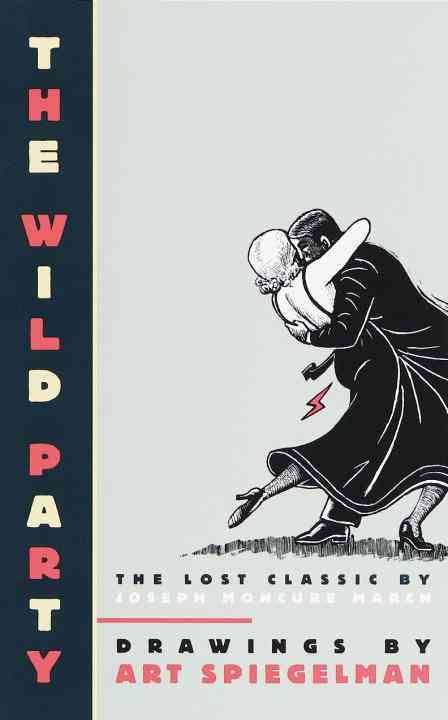
It stands to reason that March could have kept going made this poem a cop story. A wild party happens at night, one person dies and the cops arrive. It sounds like the opening scene of a good episode of “Law and Order”, “Castle”, “Hawaii Five-0”, “The Rookie” or another police drama. But, to just make it about the party, March had to end it there, chose to end it there, chose to slam the door in our faces and call it good. And, it’s considered a complete and finished work to this day, with many different adaptions, including the Broadway show, “Chicago”, which included similar lines to March’s:
“It’s good, isn’t it?
Excerpt from “The Wild Party” by Joseph Moncure March
Grand, isn’t it?
Great, isn’t it?
Swell, isn’t it?
Fun, isn’t it?
Nowadays. …
You can like the life you’re living
You can live the life you like.”
“It’s good
Isn’t it grand? Isn’t it great?
Isn’t it swell? Isn’t it fun?
Isn’t it? Nowadays”
— lyrics to “Nowadays” by Fred Ebb / John Kander from the Broadway musical, “Chicago”
Thus, March shows us the answer to this question: a work of writing only needs to be as complete as you want it to be. When you feel like it’s done, it can be done. It’s your sense of completion. And, if you ask for it, a lot of people will respect that.
Going back to continuity for a second, this means a finished work should have continuity but it’s not necessary for completion. It becomes something nice to have, rather than something that’s necessary. While everyone would certainly feel better, for example, if screenwriters didn’t take so many artistic liberties, as in “A Time to Dance”, “Summer of the Monkeys”, “Eragon” or M. Night Shyamalan’s movie, “The Last Airbender”, and, surely, this would make for a better story, everyone can agree that these movies are complete. Otherwise, there wouldn’t be a Tweetstorm about getting Disney’s attention to remake “Eragon” at the hashtag #EragonRemake.
What it means for a work, writing, to be complete, then, is subjective. Or, it is subject to collective agreement. If one person says, “Ok finished!” and we all agree with them that it is, the work is complete. Or, simply by saying, “Ok finished!” the piece could be done, subject to circumstance. Like, your term paper would not be done without meeting the requirements of the paper on your syllabus and handing it in to your teacher or professor. And, one line would not count for a complete grade. Your teacher or professor has to agree that this looks like a finished paper. But, with creative writing, or even journalism, as long as you’re not omitting any of the facts or elements you want in your creative piece or article, you can call that finished.
Recently, I was privy to a scenario between my friends, who are dating, where she had presented him a drawing she and the kids she was teaching a class for had made during church. A coloring book page, I suspect the kids had colored it and she had scrawled her name across the bottom. The page was crudely colored, with a lot of white spaces. In most cases, someone would probably say it didn’t look finished, because it wasn’t all colored in. But, she presented it to him after church, saying, “Here, I made this for you,” as if trying to be sweet. And he looked at it and said, “But, it’s not complete!” Infuriated by his remark, she said, “Ok!”, grabbed the page, ripped it in half, tore it to shreds and threw it away. This, of course, caused some shock and he said, “Hey, just a minute now..” and they began to work it out. I remarked that she would come tear my adult coloring book pages I had at home, too, because they weren’t complete. “Or,” I suggested, “perhaps they are just fine as they are.”
That night, I couldn’t sleep and found myself thinking about this scenario. I pulled out my adult coloring book and began to try to finish coloring in a coloring page of a whale I had been working on. It’s a page I can never seem to finish because it has so many details and I only have so many colored pencils. I worked on it a little bit, somehow giving the whole thing fresh perspective again. And, I thought about why I thought this drawing didn’t feel complete to me. I think it’s because everything I have wanted to color in, I haven’t colored in. I stopped for a second and took a picture, which is the key photo for this month’s post, looking at it. “Or, maybe, it’s fine as it is,” I thought.
This reminded me of a play I went to in college, starring my boyfriend at the time, now ex-boyfriend, who is an actor. It was a short play about an artist who called a blank canvas a complete artwork. The play went along with people reacting to the blank canvas and explaining how that could be so, that a blank canvas could be a finished artwork. It was a strange concept and it really begs the question of what we consider artwork. For me, it is a creative lesson I have never forgotten in my own writing and creativity.
Where does this leave the editing process, though? I believe it’s still necessary. It’s good to strive for perfection in our work.
In the September/October edition of Writer’s Digest, freelancer Paul Nicolaus emphasizes the need for editing for better continuity, this month’s quote. He makes the case that, like that term paper that won’t count if you just write one line, you can’t just slap together a piece of writing and call it good. So, while writing nothing, like that blank canvas, would be just fine, maybe it’s not as acceptable as if you actually wrote a poem or story people can read and enjoy. And, not just that, but if you took time to make it look just right through the editing process, that would be better.
It’s a lesson I was reminded of when I wrote “The Empty Chair” this month. For a semi-perfect sonnet, all I need are 8 syllables on the first line and 7 syllables all the way down the rest of the poem. I could fill the whole poem with idiosyncratic words and call it a day. Hey, just look at Lewis Carroll’s “Jabberwoky”, the classic sound poem and one of my personal favorites. But, notice that Carroll is not just spewing nonsense at the reader but telling a story. We can still understand what he’s trying to say, the story he’s trying to tell. He’s still going somewhere with this. Similarly, my poem can’t just be a mess of words. It has to be going somewhere, telling the reader something.
In this case, I myself experienced a continuity problem. How was I going to get the reader from the base of the hill, where the main character is leaning against an oak tree by Grand Traverse Bay, up the hill to where the empty Adirondack chair stands overlooking the bay? And, how to I get said character from sitting to touching the chair in the end of the poem? How do I get them from sitting in old memories to making new ones? This, then, shows character development.
But, the trick is that your audience then has to understand what you’re saying. If your message doesn’t come across as intended, you have failed to communicate. That’s why I have gotten in the habit of either being more overt or asking people: “Hey, what did you get out of that?” And then, I see what they say. This, I think, is the best way to create continuity in this and other poems or stories I write.
So, Nicolaus is right to say we can’t just slap together a pile of stink and call it done. Our message, as writers, still needs to come across well and, hopefully, as intended. The perfectionist, thus, still has a place, even if it is not necessary for completion, as I said before.
Maybe this Ad-Lib doesn’t constitute a lot of tips. And, maybe I’ve said this whole sha-bang before. But, it bears repeating: completion, especially in creative writing, is subjective. A work should be as complete as you want it to be and what makes it complete and when it is complete is up to you; however, continuity is key to holding the whole thing together. That means plugging those plotholes, developing characters and making your story go somewhere. That means not discarding the editing process and leaving a place for your inner perfectionist. But, remember: you don’t need all that to be finished. Even if it doesn’t look done to you, it’s still publishable as is, because it could also be just fine as it is. That too.
And, with that, Disney+ cheese and all, I think I will call this one done. Think about that.~
Sincerely, Your Writer,
Jessica A. McLean
…………………………………………………………………………………………………………………………………………..
Recent Happenings:
- Recent Ad-Lib Activity:
- August 2021’s Ad-Lib is here!
- Here lies my foolish thinking. A writer is dedicated, not lazy. Making a resolution to pick up monthly Ad Libs again!
- TBA: I’m working on finishing my series on form. It’s a gigantic project, so I will probably split it in two. Stay tuned.
- Recently Published:
- Poems Added:
- The Empty Chair, a semi-perfect sonnet about making new memories over old ones. This poem is dedicated to my sister, Julia, who I always love making new memories with.
- Poems Added:
- Editing, editing, and more editing.
- Waiting 🙂
……………………………………………………………………………………………………..




 The Rose