
AUTHOR’S GAB, READER TALK.
A LETTER TO YOU, THE READER, SO THAT YOU CAN FINALLY FIGURE OUT WHAT I’M THINKING.
—————————————
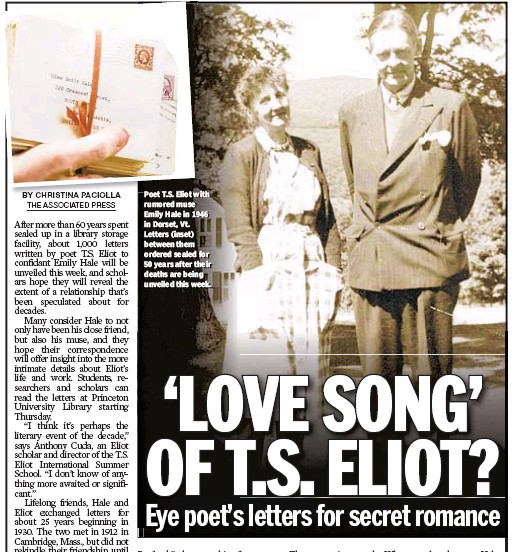
THIS MONTH: The secret of T.S. Elliot’s muse
————————————————–
“We shall not cease from exploration, and the end of all our exploring will be to arrive where we started and know the place for the first time.”
— T.S. Elliot, American poet
Dear Reader,
As you all know, I work for a local newspaper. In January, I ran across this story on The Associated Press about T.S. Eliot’s letters to his muse, Emily Hale, and I just found it so interesting. After 60 years, the letters, given to Princeton University by Hale in 1956, were to be revealed and everyone wanted to know what was inside. Was he indeed in love with her as everyone bemused? Or, were they simply pen pals? The whole thing was a mystery and headlines everywhere splashed the big reveal about the pair. Then, they cracked open the letters and found a controversy. This was a man who was, for years, in love with a woman who wasn’t his wife and couldn’t bring himself to terms that he was in love at all. It was all one big friend zone, posthumously slathered with assertions of “I never loved her at all.” I guess, even poets keep secrets, even T.S. Elliot.
The more I read about this, the more I keep thinking that people have a way to get to the bottom of those secrets, eventually, no matter how hard we writers try to cover them up. Indeed, our secrets are more fleshed out than other people’s secrets, because we bare our souls in writing. Even I have secrets, and I’ve done to my best to cloak my secrets if I write about them. Sometimes, you write something and say to yourself, “That’s better unpublished.” Then, you throw it in the bottom drawer and never think about it again, until you’re going through your stuff years later and find it, crinkled up under a stack of old pictures or something. You look at it and think to yourself, “Huh. I remember writing that. Well, THAT was a time.” Personally, I never pitch these kinds of things, but I know plenty of people that do.
I think that Emily Hale was T.S. Elliot’s biggest secret; so, when she tried to preserve his letters in a museum (he is a famous poet after all), he panicked. He tried to have the last word. He said he never loved her at all, the way someone publicly declares something to clear their name rather than whisper it in the dead of night. I love this quote from Thought Catalog:
“As one of the Princeton librarians quipped about the Eliot letter, “It reminded me of that scene in The Wizard of Oz, and the wizard is saying, ‘Pay no attention to those other 1,100 letters.’”
— Taken from the article “‘My Dearest Emily’ — The Heartbreaking Love Affair Of Emily Hale And T.S. Eliot”, Thought Catalog
T.S. Elliot fell in love with someone, but it’s almost as if he felt he shouldn’t have. Maybe he felt this way because Hale originally said she didn’t have feelings for him when he expressed his feelings for her in 1912, even if she reconsidered that idea later. According to The New York Times:
“Hale, a bright, accomplished woman who taught drama and speech at various schools, including Smith College, met Eliot in 1912, when Eliot was a graduate student of philosophy at Harvard. In his statement, Eliot said he told Hale he was in love with her in 1914, but she did not appear to reciprocate his feelings at the time.”
— Taken from the article, “The Love Letters of T.S. Eliot: New Clues Into His Most Mysterious Relationship”, The New York Times
It was like that one relationship you have where you feel like maybe it should be going somewhere but, for one reason or another, it doesn’t. I once asked my aunt, who has been single all her life, why she never married. Or, I just wanted to know why it just didn’t work out for her the way she hoped it would. “We decided to just be friends,” she said. I have always felt these are wise words, as well as a healthy word of warning for any relationship I’m in. I feel like the same thing is true with the Hale papers: despite all the attraction, they decided to just be friends.
One thing I have always said about writing, and I have said it early and I have said it often, is that writing comes from your personal experience. It doesn’t matter if you get a tip or a press release, are writing a research paper or doing any sort of work where you have to compile facts and figures, you’re still writing from your own perspective. It’s what you see. It’s the facts you can compile on the topic. And, from there, you can talk about what you’ve found. Especially when it comes down to things like writing in your diary, which is more personal, you’re writing from what you see and what you know to be true. So, I think it goes without saying that you’re going to have certain people in your life that just creep into your poetry, simply because they are on your heart and they’re easy to write about. Those people are what we call, in writing, a muse: the secret person behind the secret.
T.S. Elliot’s letters definitely reveal Hale was his muse. According to the letters, she pops up in his poems everywhere, reflecting his heart. Indeed, according to the Smithsonian:
“Many scholars believe that Hale was the inspiration behind some of Eliot’s more moving verses, including “Burnt Norton” (“Footfalls echo in the memory / Down the passage which we did not take / Towards the door we never opened / Into the rose-garden.”)”
— Taken from the article, “Emily Hale Was T.S. Eliot’s Confidante—and More, Suggest Newly Unsealed Letters”, The Smithsonian Magazine
Burnt Norton is actually one of T.S. Elliot’s more famous poems, aside from The Waste Land, which he claimed to have written about his first wife, with whom he is commonly known to have an unhappy marriage with. Still, even here, his secrets overflow into his poetry. The Smithsonian even claims Hale is responsible for the hyacinth lines in The Waste Land.
In this way, he seems a lot like Jane Austen’s character, Phillip Elton, from her novel, Emma, who passionately expresses his love to Emma Woodhouse, only to find his feelings aren’t reciprocated. He then goes off to marry someone completely different, Augusta Hawkins, much like T.S. Elliot does, twice, in his relationship with Hale: first to Vivienne Haigh-Wood, the English daughter of an artist and then to his secretary, his second wife, Esmé Valerie Fletcher, whom he married in 1957. One of my favorite lines from Emma goes this way, and it’s taken from the scene where George Knightley is chastising Emma for being rude to Miss Bates at the picnic scene. The excerpt goes like this:
Emma: “I do own myself to have been completely mistaken in Mr. Elton. There is a littleness about him which you discovered, and which I did not: and I was fully convinced of his being in love with Harriet. It was through a series of strange blunders!”
Mr. Knightley: “And, in return for your acknowledging so much, I will do you the justice to say, that you would have chosen for him better than he has chosen for himself. —Harriet Smith has some first-rate qualities, which Mrs. Elton is totally without. An unpretending, single-minded, artless girl– infinitely to be preferred by any man of sense and taste to such a woman as Mrs. Elton. I found Harriet more conversable than I expected.”
— excerpt from Volume III, Chapter 2 of Emma by Jane Austen
And that, I think, is really the secret of T.S. Elliot’s muse: everyone else has chosen better for him than he has for himself, especially by these letters. God only knows if we would have gotten such fantastic poetry if T.S. Elliot had just chosen rightly and ended up a happy man, but history is history. As it is, we have the poetry, muse intact.
I think this all lends itself to one pure lesson we shouldn’t forget: writing is a mirror. And, I’m not even talking about how it reflects our perspective here, more about how it reflects us as people, our very character and essence. So, if you want you’re writing to be good, you have to be good. It almost goes back to that age-old lesson your mother taught you about “careful who your friends are”. Or, like how I have this t-shirt I wear to bed that says, “Careful, you might end up in my novel.” And, even if it’s not you, it might be a version of you or someone else I’ve encountered. In that light, maybe I should change the shirt to say, “Careful, you might end up in my poetry,” because you might. Or, in T.S. Elliot’s case, he should have worn the same shirt to warn Emily Hale that she might end up in his reflection. Muses and secrets are nuances of the reflection we can see when we write. That’s what makes these letters so valuable, because they are part of T.S. Elliot’s reflection.
I have stated Elliot’s quote about what it means to explore, because I intended to explore the mystery of the correspondence between him and Hale. But, I want to go deeper than that and say that, when we write, it is an exploration of our character, and all that exploration leads back to that one point to help us find our reflection. If you don’t want to explore a topic, don’t hang out with the topic. If you don’t want someone to be your muse, don’t even entertain them as a possibility. And, if you don’t want secrets, don’t keep them. But, life, unfortunately, isn’t always that easy.
So, I will issue you a word of warning if you plan on writing: prepare to be exposed. Prepare to have your character examined under a microscope, much like these letters reveal T.S. Elliot’s character. And, if you don’t want that, don’t bother writing. It’s a hard way to say it, but that’s the truest I can put it. Because, if the secret to any muse, any secret, is character, who you are, then you best choose better than T.S. Elliot chose for himself, as Austen would say.
See: https://www.theatlantic.com/culture/archive/2020/04/what-ts-eliot-love-letters-reveal/609535/
Think about that. ~
Sincerely, Your Writer,
Jessica A. McLean
Recent Happenings:
- Recent Ad-Lib Activity:
- May 2020’s Ad-Lib is here!
- Here lies my foolish thinking. A writer is dedicated, not lazy. Making a resolution to pick up monthly Ad Libs again!
- Recently, I have not been keeping up with Ad-Libbing. I graduated five years ago from Oakland University with a degree in Journalism and I got a job at a local paper, The Oakland Press. I’m doing more writing, editing, designing and publishing than I could ever dream of. But, this cascade of graduating, finding a job and working hard at a job has captivated much of my time and mental faculties, leaving little time for personal reflection. I decided there just wasn’t time for Ad-Libbing, but I would keep publishing poetry, which is what I have done. I may not be able to publish Ad-Libs monthly as before, but I hope that when I get the chance suffices.
- TBA: I’m working on finishing my series on form. It’s a gigantic project, so I will probably split it in two. Stay tuned.
- Recently, I have not been keeping up with Ad-Libbing. I graduated five years ago from Oakland University with a degree in Journalism and I got a job at a local paper, The Oakland Press. I’m doing more writing, editing, designing and publishing than I could ever dream of. But, this cascade of graduating, finding a job and working hard at a job has captivated much of my time and mental faculties, leaving little time for personal reflection. I decided there just wasn’t time for Ad-Libbing, but I would keep publishing poetry, which is what I have done. I may not be able to publish Ad-Libs monthly as before, but I hope that when I get the chance suffices.
- Recently Published:
- Poems Added:
- “Coming to America”, a sestina about the story of what happened to make my mother’s family decide to immigrate to the United States. I’m very proud to say that, after 5 years or more of wanting to write one, this is my the first sestina I have ever written. As such, I consider it a major literary feat for me.
- Important: Due to the story’s sensitive nature, this poem is password protected. If you would like the password, please reach out to me via email at jessmax1hope@comcast.net.
- “Nativity”, a sonnet about the Christmas story
- “Coming to America”, a sestina about the story of what happened to make my mother’s family decide to immigrate to the United States. I’m very proud to say that, after 5 years or more of wanting to write one, this is my the first sestina I have ever written. As such, I consider it a major literary feat for me.
- Poems Added:
- Editing, editing, and more editing.
- Waiting 🙂
……………………………………………………………………………………………………..




 The Rose