
AUTHOR’S GAB, READER TALK.
A LETTER TO YOU, THE READER, SO THAT YOU CAN FINALLY FIGURE OUT WHAT I’M THINKING.
————————————————-
THIS MONTH: A Note on Form
————————————————–

“This morning (my son) says, ‘Wow, our dishes are overflowing. You’re the glue that holds this family together. Without you we are animals!’”
— Nicole Coulter, Hut Outreach coordinator
Dear Reader,
Last summer, I went to Les Cayes, Haiti on a mission trip with Hut Outreach. The coordinator and fearless leader of the ministry there is Nicole Coulter, whom we traveled with down to Haiti. We also traveled with her son, Nathan, and her parents, Pam and Jim Stanton. Nathan is kind of an awesome, nerdy kid, and we really connected over Pokemon Sun and Moon (despite the game actually not working due to spotty Haiti WiFi!); and, Gram Pam and Grandpa Jim were pretty much the coolest 39-year-old people around. 😉
We were obviously not the only team Nicole has led down to Haiti. In fact, there are many teams that go year-round. I remember Nicole telling me, as we walked through the airport in Miami, just how back and forth she has been over the years, with one foot in the States and one foot leading teams to Haiti like every other month. She really throws herself into helping people there, and that is SO AMAZING. Honestly, God bless Nicole for all she does for the people of Haiti. She is a real blessing to us all. I mean that!
She recently led a trip of students down to Haiti for spring break, and will be going again in May. I don’t think Nathan went on this trip, nor do I think Gram Pam or Grandpa Jim went either. I could be wrong. Correct me if I am!
Anyway, Nicole was gone for a total of about a week. And, when she returned, she quoted Nathan as saying, “Wow, our dishes are overflowing. You’re the glue that holds this family together. Without you we are animals!”
Just like Nicole and Nathan, it goes without saying that a mom is the glue that holds many families together. She calms the circus and brings order to the disorderly. She hugs, cares and nurtures for her family. Without moms, life would be a chaotic three-ring circus without much end to it.
Like moms, writing has to have some glue that holds it together. It has to take shape, have some form to it. Without form, writing would be just a hodgepodge of words on a page, a never-ending disaster. Even writing, it seems, needs a mom!
For example, an essay is an essay because it has a beginning paragraph to it, three middle paragraphs and an ending paragraph to it, with no more than about 8 sentences per paragraph. Or, a novel is a novel because it has 30 chapters in it and 500 pages and will probably take you more than one sitting to read. Or, an article is an article because it has a lede sentence, a nut graph and short explanations and quotes, it can end just about anywhere and hopes to convey truth about something current.
Such structure defines how we see writing. And, with poetry, I have been nothing short of obsessed with it. In fact, I have found the topic so interesting, that I have based the anthology I have been working on for at least the past 10 years on this very thing. In short, it is definitely something I have been thinking about with every poem I write.
Because, with structure, you can make so many different things. It is always about how you see the light filtering through the windowpane, in what meter and structure that can change exactly what that light filtering through the windowpane means. Because, you can always have light filtering through windows, but you can’t connect it to something greater in a poem without structuring it.
Of course, you can have poems without form, and these are called free-verse poems. I have written a few myself. Basically, you drop all norms of standard form and write whatever the heck you feel like writing and hope it makes sense somehow, like an abstract painting.
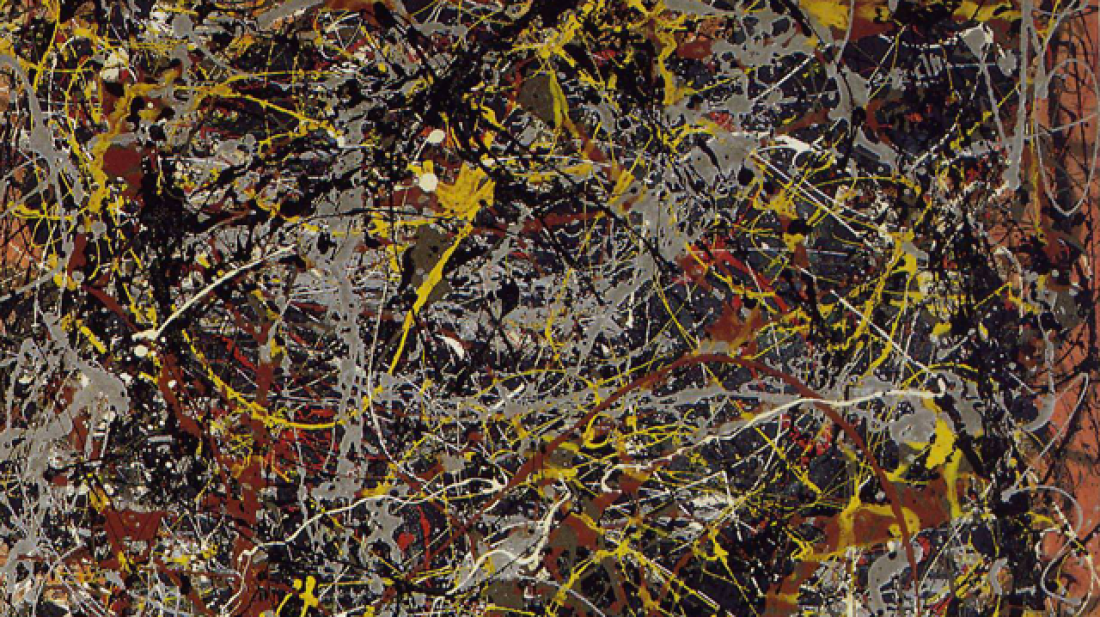
But, even abstract paintings end up looking like something eventually. Some end up looking like this Jackson Pollock, a huge soup of colors:
Others end up with more structure, such as this famous work by Piet Mondrian:

The point being that they take on some form. Even the whitest of canvases becomes something by being blank. Even a rest in a piece of music, by being nothing, adds character to the whole piece of music. And so, in poetry, even works of free verse are forms themselves, simply by not having any.
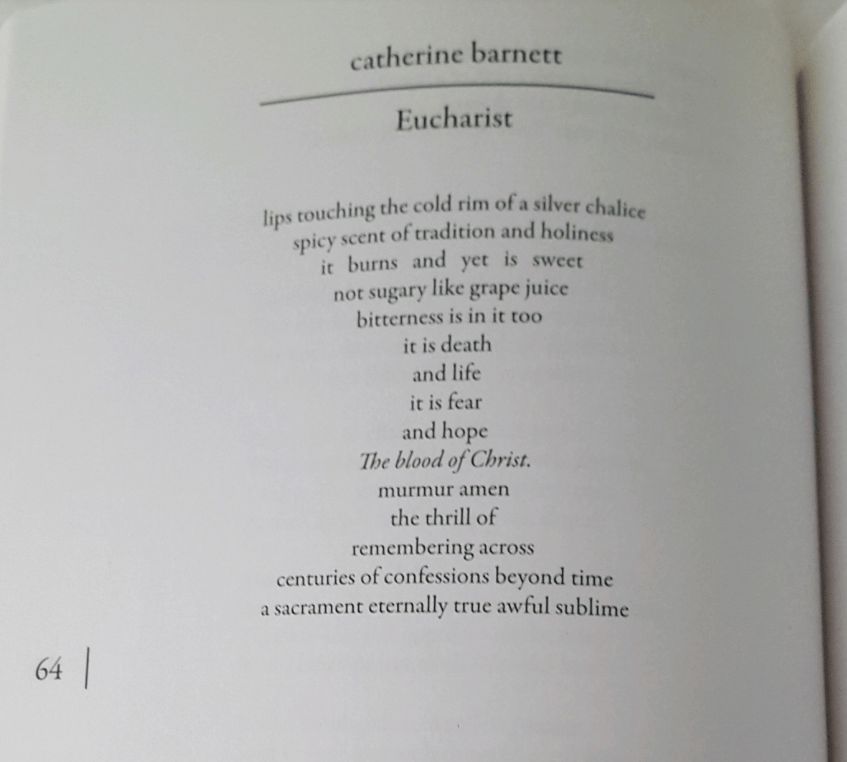
I learned this the hard way when I began writing poetry because I didn’t want to deal with form. I wrote many works of free verse, just because I was lazy and meter was too hard. But, you know what? Perhaps one of my best early works, “The Chess Game”, looks like a chess piece. Or, for example, in 2009, “Eucharist”, the winning poem in Parnassus, the literary journal I used to submit to at Taylor University, was a free verse poem shaped like a communion chalice. It looked a little something like this:
I recently have been trying to pull together my work on form, so I thought it would be helpful to me and to you to run through a few examples of poetic form, traditional and some non-traditional. One I had not even heard of before until I sat down in the library this month and found out about it. Some I have written before, others I have not. For brevity’s sake, I will give these forms in a bulleted list, with a brief description and some comments if necessary. I will provide an example with each. These are all forms you can use when writing poetry, all things you can do to hold your work together and create meaning.
- (Author’s Sidenote: Many of the below comments are researched ands taken from The Making of A Poem: A Norton Anthology of Poetic Forms by Mark Strand and Even Boland and The Norton Anthology of Poetry by Margaret Ferguson, Mary Jo Salter and Jon Stallworthy. As everyone knows, it’s always important to cite your sources, so consider them cited.)
It’s important to note here that the forms covered here are lyrical, i.e. a fairly short poem in the voice of a single speaker, rather than epical, a very long poem composed on a single topic, or dramatic, a monologue or dialogue, written in the voice of a character assumed by the poet. Thus, we are only covering one category of poetry here out of three, and will save the other two for another rainy day. Although I may never write a whole epic or a play, Homer’s “The Iliad” or James Merrill’s “The Changing Light at Sandover” and some of the great dramas definitely deserve some thought here.
The lyrical forms we are covering today are as follows:
- Open Form/Free Verse/Closed Forms: The form that is no form, this form of poetry makes little to no use of traditional rhyme and meter. Over the course of recent history, poets have used this form to question form, since free verse can become just about anything. “Eucharist” is a perfect example, and there are many, many more examples to count. Perhaps a more famous free verse you might recognize is Sylvia Plath‘s “Daddy”:
Daddy
By Sylvia PlathYou do not do, you do not doAny more, black shoeIn which I have lived like a footFor thirty years, poor and white,Barely daring to breathe or Achoo.Daddy, I have had to kill you.You died before I had time——Marble-heavy, a bag full of God,Ghastly statue with one gray toeBig as a Frisco sealAnd a head in the freakish AtlanticWhere it pours bean green over blueIn the waters off beautiful Nauset.I used to pray to recover you.Ach, du.In the German tongue, in the Polish townScraped flat by the rollerOf wars, wars, wars.But the name of the town is common.My Polack friendSays there are a dozen or two.So I never could tell where youPut your foot, your root,I never could talk to you.The tongue stuck in my jaw.It stuck in a barb wire snare.Ich, ich, ich, ich,I could hardly speak.I thought every German was you.And the language obsceneAn engine, an engineChuffing me off like a Jew.A Jew to Dachau, Auschwitz, Belsen.I began to talk like a Jew.I think I may well be a Jew.The snows of the Tyrol, the clear beer of ViennaAre not very pure or true.With my gipsy ancestress and my weird luckAnd my Taroc pack and my Taroc packI may be a bit of a Jew.I have always been scared of you,With your Luftwaffe, your gobbledygoo.And your neat mustacheAnd your Aryan eye, bright blue.Panzer-man, panzer-man, O You——Not God but a swastikaSo black no sky could squeak through.Every woman adores a Fascist,The boot in the face, the bruteBrute heart of a brute like you.You stand at the blackboard, daddy,In the picture I have of you,A cleft in your chin instead of your footBut no less a devil for that, no notAny less the black man whoBit my pretty red heart in two.I was ten when they buried you.At twenty I tried to dieAnd get back, back, back to you.I thought even the bones would do.But they pulled me out of the sack,And they stuck me together with glue.And then I knew what to do.I made a model of you,A man in black with a Meinkampf lookAnd a love of the rack and the screw.And I said I do, I do.So daddy, I’m finally through.The black telephone’s off at the root,The voices just can’t worm through.If I’ve killed one man, I’ve killed two——The vampire who said he was youAnd drank my blood for a year,Seven years, if you want to know.Daddy, you can lie back now.There’s a stake in your fat black heartAnd the villagers never liked you.They are dancing and stamping on you.They always knew it was you.Daddy, daddy, you bastard, I’m through.
- Two (Couplet), Three (Tercet) and Four Lines (Quatrain) : If you ever look at the meat and potatoes of poetry, it will almost always compose itself around these three forms. And, you’ll see it in textbooks, too, like “The couplet, blah blah blah” or “The quatrain, blah blah blah”. So, it’s important to recognize these forms, because they’re what other forms are built on. The couplet is two lines of verse, usually coupled by rhyme, the basic unit of English poetry since rhyme entered language. Meaning, with many of these put together, you can create longer forms of poetry.
- The Heroic Couplet is a from which is composed of two lines that rhyme on the end word, like, “I went to climb the tree./From the top, there was so much to see.” It is usually composed in iambic pentameter or tetrameter, with a rhyme scheme of aabbcc. This is probably the form most people are familiar with and try to replicate when they first try to compose poetry. An example is Anne Bradstreet’s “An Author to Her Book”:
The Author to Her Book
By Anne BradstreetThou ill-form’d offspring of my feeble brain,Who after birth didst by my side remain,Till snatched from thence by friends, less wise than true,Who thee abroad, expos’d to publick view,Made thee in raggs, halting to th’ press to trudge,Where errors were not lessened (all may judg).At thy return my blushing was not small,My rambling brat (in print) should mother call,I cast thee by as one unfit for light,Thy Visage was so irksome in my sight;Yet being mine own, at length affection wouldThy blemishes amend, if so I could:I wash’d thy face, but more defects I saw,And rubbing off a spot, still made a flaw.I stretched thy joynts to make thee even feet,Yet still thou run’st more hobling then is meet;In better dress to trim thee was my mind,But nought save home-spun Cloth, i’ th’ house I find.In this array ’mongst Vulgars mayst thou roam.In Criticks hands, beware thou dost not come;And take thy way where yet thou art not known,If for thy Father askt, say, thou hadst none:And for thy Mother, she alas is poor,Which caus’d her thus to send thee out of door.
- Here is an example of a contemporary author who wrote a book of heroic couplets. I got the book, have really been enjoying it so far (his allusion and metaphor regarding people and the slaughterhouse is a gimme for any poetry reader) and think it is a good investment: https://www.newyorker.com/books/page-turner/david-rakoffs-heroic-couplets

Excerpt from “Margaret” (“Love. Dishonor. Marry. Die. Cherish. Perish,” by David Rakoff, page 5):
“They’d met on the streetcar en route to the slaughter-
house, she the young widow, a six-year-old daughter,
And soon there were three, and ere long, for her sins
They’d grown now to five, with a pair of boy twins.”
- Blank Verse: Blank verse consists of unrhymed, or “blank”, iambic pentameters. Closest to spoken English, these poems are divided into verse paragraphs of varying length, rather than having stanzas of equal length. One tends to find them in more dramatic forms of poetry, a predominant example being John Milton’s Paradise Lost. A shorter example we can see here is Wallace Stevens’ “Sunday Morning“:
Sunday Morning
By Wallace StevensIComplacencies of the peignoir, and lateCoffee and oranges in a sunny chair,And the green freedom of a cockatooUpon a rug mingle to dissipateThe holy hush of ancient sacrifice.She dreams a little, and she feels the darkEncroachment of that old catastrophe,As a calm darkens among water-lights.The pungent oranges and bright, green wingsSeem things in some procession of the dead,Winding across wide water, without sound.The day is like wide water, without sound,Stilled for the passing of her dreaming feetOver the seas, to silent Palestine,Dominion of the blood and sepulchre.IIWhy should she give her bounty to the dead?What is divinity if it can comeOnly in silent shadows and in dreams?Shall she not find in comforts of the sun,In pungent fruit and bright, green wings, or elseIn any balm or beauty of the earth,Things to be cherished like the thought of heaven?Divinity must live within herself:Passions of rain, or moods in falling snow;Grievings in loneliness, or unsubduedElations when the forest blooms; gustyEmotions on wet roads on autumn nights;All pleasures and all pains, rememberingThe bough of summer and the winter branch.These are the measures destined for her soul.IIIJove in the clouds had his inhuman birth.No mother suckled him, no sweet land gaveLarge-mannered motions to his mythy mind.He moved among us, as a muttering king,Magnificent, would move among his hinds,Until our blood, commingling, virginal,With heaven, brought such requital to desireThe very hinds discerned it, in a star.Shall our blood fail? Or shall it come to beThe blood of paradise? And shall the earthSeem all of paradise that we shall know?The sky will be much friendlier then than now,A part of labor and a part of pain,And next in glory to enduring love,Not this dividing and indifferent blue.IVShe says, “I am content when wakened birds,Before they fly, test the realityOf misty fields, by their sweet questionings;But when the birds are gone, and their warm fieldsReturn no more, where, then, is paradise?”There is not any haunt of prophecy,Nor any old chimera of the grave,Neither the golden underground, nor isleMelodious, where spirits gat them home,Nor visionary south, nor cloudy palmRemote on heaven’s hill, that has enduredAs April’s green endures; or will endureLike her remembrance of awakened birds,Or her desire for June and evening, tippedBy the consummation of the swallow’s wings.VShe says, “But in contentment I still feelThe need of some imperishable bliss.”Death is the mother of beauty; hence from her,Alone, shall come fulfilment to our dreamsAnd our desires. Although she strews the leavesOf sure obliteration on our paths,The path sick sorrow took, the many pathsWhere triumph rang its brassy phrase, or loveWhispered a little out of tenderness,She makes the willow shiver in the sunFor maidens who were wont to sit and gazeUpon the grass, relinquished to their feet.She causes boys to pile new plums and pearsOn disregarded plate. The maidens tasteAnd stray impassioned in the littering leaves.VIIs there no change of death in paradise?Does ripe fruit never fall? Or do the boughsHang always heavy in that perfect sky,Unchanging, yet so like our perishing earth,With rivers like our own that seek for seasThey never find, the same receding shoresThat never touch with inarticulate pang?Why set the pear upon those river-banksOr spice the shores with odors of the plum?Alas, that they should wear our colors there,The silken weavings of our afternoons,And pick the strings of our insipid lutes!Death is the mother of beauty, mystical,Within whose burning bosom we deviseOur earthly mothers waiting, sleeplessly.VIISupple and turbulent, a ring of menShall chant in orgy on a summer mornTheir boisterous devotion to the sun,Not as a god, but as a god might be,Naked among them, like a savage source.Their chant shall be a chant of paradise,Out of their blood, returning to the sky;And in their chant shall enter, voice by voice,The windy lake wherein their lord delights,The trees, like serafin, and echoing hills,That choir among themselves long afterward.They shall know well the heavenly fellowshipOf men that perish and of summer morn.And whence they came and whither they shall goThe dew upon their feet shall manifest.VIIIShe hears, upon that water without sound,A voice that cries, “The tomb in PalestineIs not the porch of spirits lingering.It is the grave of Jesus, where he lay.”We live in an old chaos of the sun,Or old dependency of day and night,Or island solitude, unsponsored, free,Of that wide water, inescapable.Deer walk upon our mountains, and the quailWhistle about us their spontaneous cries;Sweet berries ripen in the wilderness;And, in the isolation of the sky,At evening, casual flocks of pigeons makeAmbiguous undulations as they sink,Downward to darkness, on extended wings.
- Most Common Forms:
- Sonnet: Arguably the most classic of traditional forms, the sonnet is a poem composed of fourteen lines with ten syllables each in iambic pentameter. There are two basic types of sonnets, varying only by meter: the Petrarchan (Italian) sonnet and the Shakespearian (English) sonnet. Notably, the Spencerian sonnet (a sonnet in which the lines are grouped into three interlocked quatrains and a couplet and the rhyme scheme is abab, bcbc, cdcd, ee) is a form of the Shakesperian sonnet. Also, modern poets have taken the sonnet and developed interesting versions and forms of it (see Semi-Perfect Sonnets), but the basic idea is still the same. The sonnet at the beginning of this post, “On the Sonnet” by John Keats is also an example, wherein Keats writes about sonnets and poetic form in the classical poetic form of a sonnet. You will also see that I have written several sonnets myself on this blog, such as “Crimson (An Italian Sonnet)” (a Petrarchan/Italian sonnet) and many others, such as “Here,” and “A Stray Dog“.
- Petrarchan (Italian) sonnet example:
When I Consider How My Light Is Spent
By John Milton
When I consider how my light is spent,
Ere half my days in this dark world and wide,
And that one talent which is death to hide
Lodged with me useless, though my soul more bent
To serve therewith my Maker, and present
My true account, lest He returning chide;
“Doth God exact day-labor, light denied?”
I fondly ask. But Patience, to prevent
That murmur, soon replies, “God doth not need
Either man’s work or His own gifts. Who best
Bear His mild yoke, they serve Him best. His state
Is kingly: thousands at His bidding speed,
And post o’er land and ocean without rest;
They also serve who only stand and wait.” - Shakesperian (English) sonnet (reader note Spencerian sonnet) example:
- Petrarchan (Italian) sonnet example:
- Sonnet: Arguably the most classic of traditional forms, the sonnet is a poem composed of fourteen lines with ten syllables each in iambic pentameter. There are two basic types of sonnets, varying only by meter: the Petrarchan (Italian) sonnet and the Shakespearian (English) sonnet. Notably, the Spencerian sonnet (a sonnet in which the lines are grouped into three interlocked quatrains and a couplet and the rhyme scheme is abab, bcbc, cdcd, ee) is a form of the Shakesperian sonnet. Also, modern poets have taken the sonnet and developed interesting versions and forms of it (see Semi-Perfect Sonnets), but the basic idea is still the same. The sonnet at the beginning of this post, “On the Sonnet” by John Keats is also an example, wherein Keats writes about sonnets and poetic form in the classical poetic form of a sonnet. You will also see that I have written several sonnets myself on this blog, such as “Crimson (An Italian Sonnet)” (a Petrarchan/Italian sonnet) and many others, such as “Here,” and “A Stray Dog“.
“Sonnet 18”, by William Shakespeare
“Shall I compare thee to a summer’s day?
Thou art more lovely and more temperate.
Rough winds do shake the darling buds of May,
And summer’s lease hath all too short a date.
Sometime too hot the eye of heaven shines,
And often is his gold complexion dimmed;
And every fair from fair sometime declines,
By chance, or nature’s changing course, untrimmed;
But thy eternal summer shall not fade,
Nor lose possession of that fair thou ow’st,
Nor shall death brag thou wand’rest in his shade,
When in eternal lines to Time thou grow’st.
So long as men can breathe, or eyes can see,
So long lives this, and this gives life to thee.”
- Villanelle:
- Sestina:
I want to insert an honest note here and admit that I actually do not have time to cover every form, however brief, in this post this month. I’m definitely past time in working on this, so I’m going to divide this up and say I will cover the following forms at a later date. Hopefully, this will also save you some time as you go through these forms. Maybe you will be able to process them better in bite-sized chunks, rather than all at once. Thus, I will simply share these main forms above and return to the forms below at a later date:
- Other Notable Forms (to be covered at a later date):
- Etheree
- Canzone
- Pastorial
- Pantoum
- Limerick
- Prose Poetry
- Found Poetry
- Shaped Poetry
- Concrete Poetry
- Sound Poetry
- A Form of My Invention:
- Semi-Perfect Sonnet:
And so, these are the “moms” of poetry. Without them, there would be pure chaos. Nothing would make sense.
I encourage you to just pick a form and try writing one. Start by writing out your thoughts and just shaping it to the form you chose. I know it will be a challenge you won’t regret. And, maybe, your dishes will even be done afterwards. Thanks, mom!
Think about that.~
Sincerely, Your Writer,
Jessica A. McLean





 The Rose