
Author’s Gab, Reader Talk.
A letter to you, the reader, so that you can finally figure out what I’m thinking.
—————————————
This Month: Thoughts on Publication
————————————————–
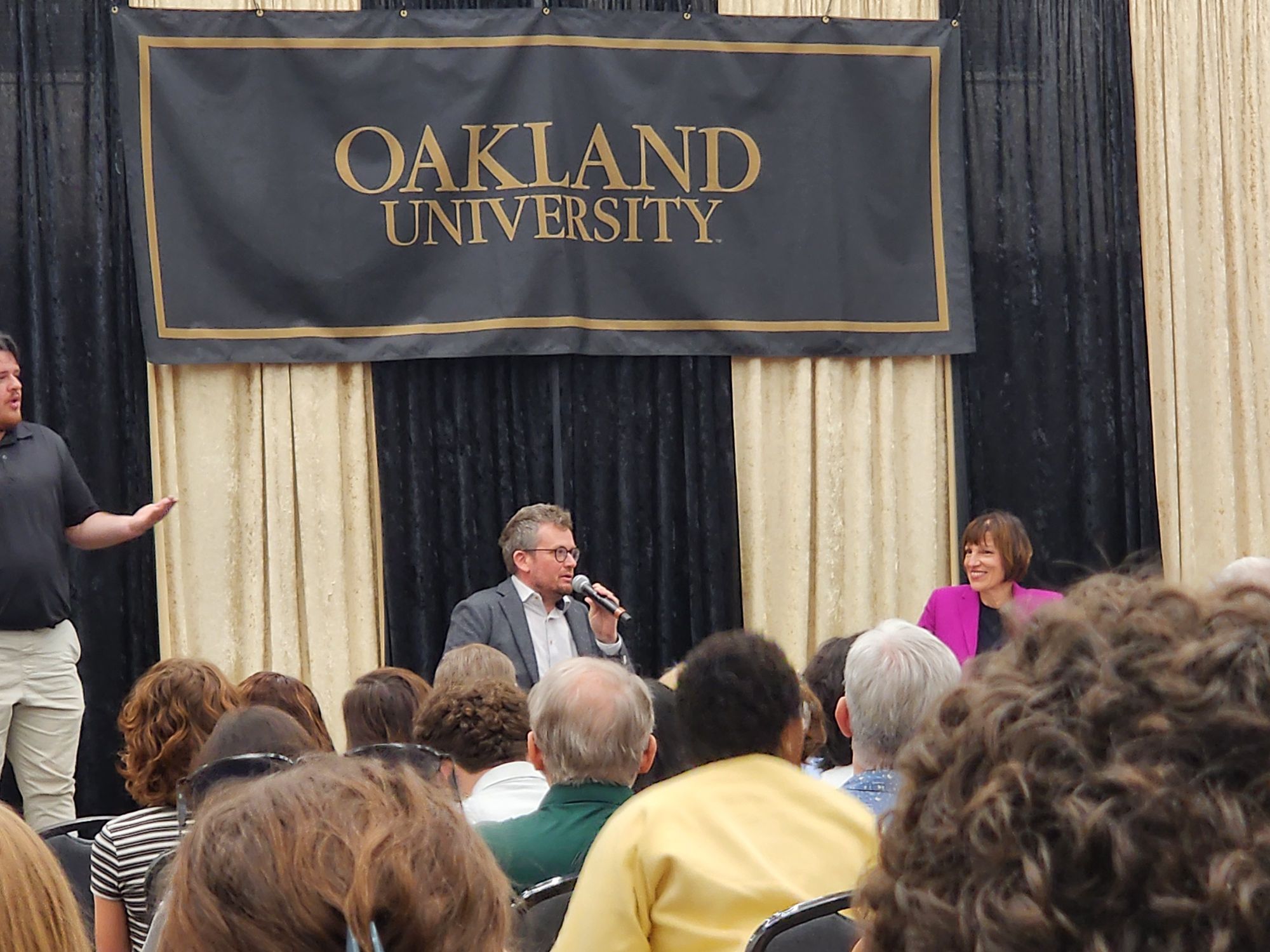
“For me, writing is about the work itself, to make things for you and you for me… And, that’s the proper exchange when it comes to art, is to make things as gifts for people.”
— John Greene, author and YouTuber, speaking at Oakland University in October 2025
Dear Readers,
I will start with a disclaimer: I’m not an expert on publishing. I’m not in the professional publishing business. People always ask me if I can edit their manuscript. I cannot. I’m not that kind of editor. If anything, I’m a journalistic editor; and, that is something I haven’t practiced in several years now. Furthermore, I probably need someone who is in the publishing business to help me out, for all the publishing I want to do in the future. Of course, there’s always self-publishing; and, I think that’s a good option too, especially because you get to keep your rights if you do that. But, I think this is what has been holding me back from writing this Ad-Lib, because I don’t want to sit here and tell you I know everything about publishing. I do not. I just want to make that clear from the get-go.
But, I have been thinking about publishing a lot lately in my writing. This is because I have a lot of stuff I have written over this past year I have kept close to my chest and haven’t published, for one reason or another. And so, there’s a lot of stuff I’m working on you all can’t see yet. Of course, I have released what I can, and that stuff is up on the website. But, behind the scenes, I’m working on writing a historical fantasy novel based on the fairy tale, “Boots and his Brothers”, a rewrite from my childhood years. The research and worldbuilding for this book is extensive and time consuming. It definitely has become something much bigger than it was when I was ten. I can attest to many a late night working on this, after which it never seems to be finished. It’s just a drop in the proverbial bucket. I have put up a sample chapter for all of you, but I can’t help but feel that still needs editing too.
I can say this for my poetry as well. I did a lot of writing in the fall, but some things are just still stuck in drafts for one reason or another. I wrote my second sestina ever, only to have it get stuck in the editing stage. This was out of respect for my mom, whom the poem referenced. Inspired by Amanda Gorman, I tried my hand at some political and racial poetry, only to fear it might offend some of you unnecessarily; so, that too stayed unpublished, at least until I can verify it is not offensive. I also wrote some Haiku on the topic of dirt, which also remained unpublished. And, I actually have been working on another sonnet, but I’m just not finished editing yet. Still, you might see that one soon. I’m working on filling out my villanelles, sestinas and etheree right now. I have a lot of semi-perfect sonnets and sonnets, so I was just trying to focus on rounding out some of my other forms. This is because I want to publish a collection of my work, and I would ideally like ten poems of each form (villanelle, sestina, etheree, sonnet and semi-perfect sonnet) in the final draft. So, there’s just a lot brewing here. I think that’s the bottom line.
I have definitely shared my opinions about publishing before on this blog; but, in case you forgot, let me briefly remind you. It used to be that, as a child, I was more than happy to give my work some daylight. Once I had finished something, I showed it to everybody, revised or unrevised. My family was my biggest connoisseur of my writing, and they were all convinced I should write Hallmark cards when I grew up. And then, the internet was invented. Suddenly, something was publishable by the click of a button for the entire world to see, not just my family. Putting something up on my blog suddenly became almost more formal; and, people advised me to be careful what I put online, because of that wider audience. But, the biggest lesson came in writing camp at Interlochen, when my teacher told me that anything I let someone read was in and of itself “publishing”, especially if it was not someone else in my discipline of creative writing. So, I think I just became more careful what I submitted into the vernacular as I got older. I definitely have become more careful about it. But, ultimately, that’s as style of publishing I’m comfortable with; and, I think that’s for the best. I think I agree with Virginia Woolf when she said:
“For heaven’s sake, publish nothing before you are thirty.”
I will also say that I have never had a large work published conventionally. I know that probably differentiates me from a lot of writers. But, it’s not like I’m an amateur. I have been getting Writer’s Digest for years, same as the rest of you. I mean, this blog is almost 20 years old. I have had plenty of time in pursuit of my craft to get good at it. I will say it’s definitely a goal. It’s not one I have realized myself yet, but it’s one I’m steadily working towards. But too, I know conventional publishing isn’t the only route. Self-publishing exists and is a fine route to store shelves. Magazine submission is never out of the question. And heck, this blog is absolutely just fine too.
This October, all my thoughts on publishing really converged, however, when John Green came to speak at Oakland University. I happened to be there for another event; but, after my event was finished, I decided to stick around for his talk. I’m mostly familiar with Green from watching “The Fault in Our Stars” on the big screen. It took me a second, for that reason, to figure out who he was. All the kids were talking about his YouTube series, CrashCourse, which he started with his brother, Hank, which was also something I hadn’t heard of before then. But, once I got into the talk, I really enjoyed it. Green discussed his journey of authorship, and it was interesting to hear how he went from writing a fictional work like “The Fault in Our Stars” to a non-fiction work as he most recently wrote, “Everything is Tuberculosis”. I think, most interestingly, he talked about how his interacting with the fandom influenced the kinds of books he wanted to write, driving him from fiction to non-fiction and back again. The Oakland Post wrote an article on his talk if you want more information on it: https://oaklandpostonline.com/54766/campus/a-conversation-on-radical-hope-with-john-green/
But, as Green discussed publishing his works, one quote really stuck out to me:
“For me, writing is about the work itself, to make things for you and you for me.. And, that’s the proper exchange when it comes to art, is to make things as gifts for people.”
And, when asked what he wanted everyone to get out of the talk, Green said:
“I hope you walk away with the idea that hope is the miracle of consciousness.”
When it comes to publication, I can’t think of a better way to say it than that. Putting something out there is like a gift of consciousness to the world. When the gift is ready to be given, we give it. When it’s not, we hold it back. And, it’s that perceiving and being perceived, giving and receiving of information, that motivates us to continue the exchange.
I’d like to say I caved and bought “Everything is Tuberculosis” right away; but, I didn’t. Instead, I was sitting in Chick-fil-A across from Oakland University, when some students came in and sat down next to me and started raving about his talk. “I’ve already finished his book,” one girl boasted. And, I realized I hadn’t, so I bought it, along with “The Fault in Our Stars”, of course. I haven’t read the whole book straight through, but I love how he doesn’t talk about tuberculosis clinically. He gives it to you in almost a bite-sized, Mitch Albom-sized spoonful. I love lines like the following on page 38:
“And so, how did one arrive at a diagnosis? Largely through patient history and observation, which remain hallmarks of a doctor’s visit today, even if we now have better ways of observing the body and its machinations. The classical physician was a kind of detective whose job was to listen carefully to a person’s story, pay close attention to their appearance, and then use that information to identify a culprit.”
After which, he footnotes:
“It’s no coincidence Sir Arthur Conan Doyle, who created the deductionist detective Sherlock Holmes, was — as we’ll learn later — a physician and tuberculosis researcher.”
And, who doesn’t love Sherlock Holmes? But, you see, there again is that weaving together of information, wrought from a lot of reading, the push to put something forward and deriving a “diagnosis” of what can be put forward. And then, Green integrated it and put it forward: a method of publication!
I also want to just briefly add here that Green recommended a book I ended up buying that had one of the best hooks I have seen in awhile. The book is called “Martyr!” by Kaveh Akbar, and it’s about Cyrus Shams, a struggling poet who goes on a bit of a journey into his past. But, even if I never read the whole book, I would be satisfied with just this one opener:
“”I would die for you,” Cyrus said alone to his reflection in the little hospital mirror. He wasn’t sure he meant it, but it felt good to say. For weeks, he had been playing at dying.”
And, for a book called “Martyr!” that is a damn good opening line. And, if you’re looking for a dive into the human consciousness, this book is going to take you there. Because, it’s that kind of book.
I digress, hooks are a topic for a different day. But, I think it’s also important, while I’m alluding to hooks, to say that publication is not where your work goes to die. It’s where it goes to live (after you’re done writing it). And, in a way, you are Cyrus as the writer, the martyr who is playing at dying, dying and living for whatever you are putting out there. Because, you see, once you write something down and it goes out of your consciousness, it slips into the consciousness of others. And, I think that’s a consequence people don’t always want to consider. They just want to put their stuff out there and that’s it; but, that’s not how it works. Instead, publication is communion and the publish button is the altar. It’s a two-way street.
After Green’s talk, I ran into one of my friends, whom I thanked for watching my cat, Midnight, this summer while I was on vacation. While we were sitting there chatting, one of her friends came up to say hi. As it turns out, that friend was Rebecca Mix, a local author who had also attended Oakland University and now has several books published, including her debut novel, “The Ones We Burn” and her most recent release, “I Killed the King”, both of which I now own. She talked about her route to conventional publishing and how, like Green, she interacted with her fan base. She said she sold her rights to the books, because they were just products to her. And, she said she enjoyed reaping the benefits conventional publishing offered her. To be frank, she seemed engulfed in her own success, and perhaps a bit haughty for that reason. But, she did have a published book and I did not, as she pointed out, so I decided to look her up.
The rain of criticism for her debut novel online was debilitating. One commentator, I remember, said it was probably cathartic for her to write the book; however, her lack of racial sensitivity was disturbing. How did this book make it to print when it offended so many people? Mix countered by saying it had only gotten one sensitivity read by the publishing company. But still, I think it’s a fair point that you should think about your own racial slant when you’re writing it. Even in my own work, I try to be really sensitive to how I cast people racially. I think that’s a basic read-over before publishing. Saying that, however, I think it can be hard to diagnose your own bias. One thing this did make me look into for my own book was how racially diverse Europe was in the nineteenth century and seek to try to incorporate more characters into my story of different faces and cultural backgrounds than just a uniformly white Europe.
Nonetheless, in starting 2026, I have picked up “The Ones We Burn”, because all this talk has me curious. I would also like to know what this story actually is. And, I’m all for reading other people’s hard work and providing feedback. So, I read the first couple chapters, wondered how Mix was published and I wasn’t and jumped to the back, where I found the acknowledgements. Contrary to all her defending online, these acknowledgements are an ode to Mix’s happiness in publishing the book. But, especially as I write my main character, Conrad, I had to chuckle at her acknowledgement to her main character, Ranka:
“Ranka, I’m very sorry for literally everything that happens in this book. I didn’t know at the time, but when I was writing your path to healing, I was writing mine, too. You made my dreams come true. And, I am so glad you are everyone else’s problem now.”
Really? Because, won’t Ranka always been Mix’s problem, just like Conrad is always going to be my problem? Because, you carry your characters with you. You don’t just spit them out into the vernacular when you publish them. They came from you, and so they stay with you. That’s part of writing.
Of course, maybe I should apologize to Conrad. When I first conceived of him, I was a fifth grade girl and he was the embodiment of my childhood experience, pretty much the only person who knew what I was going through. And, at that time, I called him “Tipsey”, because of his malformed left leg. But, this turned out to be an unfortunate nickname, as people immediately associated it with drunkenness. And so, when I began to form his character into something more cohesive, I changed his name to Conrad, keeping Tipsey as just a nickname, as sort of an ode to his origin. So, I’m sorry, Conrad, for making you look drunk all these years. But, in reality, I know you’re a good kid, and a smart one at that. Emma is luckier than she knows to have you. Your father never wanted to admit it, but he loved you and was lucky to have you too. I think you’ve grown up along with me, but I’m still thankful you will always choose to do the right thing and help someone out. You are my optimism to my pessimism, what I hope to be as a better individual. And still, life isn’t always fair. You don’t always get to go home. Sometimes, you have to stay and fight the battle, because the battle needs to be won. And, I’m sorry I had to do that to you too, because I know how homesick you are. I think, though, in the end, it made you a better man, a man I’m proud to say I thought of and know well.
In this sense, publication is sharing what you carry with you. It gets to the heart of what you are communing about. Like, I think, if Christopher Paolini had published “Eragon” and said he was now everyone else’s problem, we wouldn’t be where we are with the series today. Instead, he owns the character. Eragon is a part of Paolini like Conrad is a part of me and Ranka is a part of Mix. Like Mufasa, our content lives in us, like it lives in the vernacular, once we put it out there. And, this, truly, is publication.
I will say, if there is one author in particular that embodies this, it’s YouTuber, Jill Bearup, who made her characters, Caroline Lindley and Lady Rosamund Hawkhurst resemble her, because she played them in her YouTube shorts. These shorts eventually ended up as the book, “Just Stab Me Now”, for which I now own a paperback and audiobook copy. One thing I actually like about the YouTube series and about the book itself is how it pokes at tropes and the writing process through the discourse between the characters. But, when Bearup was going to publish the book, this breaking of the fourth wall was why conventional publishers, she said, didn’t want to take on her book. It didn’t fit the mold, they said. And so, she published it herself through self-publishing. She publishes how the book is doing on YouTube and has had what I feel is amazing success. Moreover, I admire her for sticking to her work and keeping her rights and not caving to the molds of traditional publishing. She’s also known as the “sword lady” on YouTube, and I like watching her analysis of swordplay also.
Bearup’s form of publication wasn’t a conventional one. It was a sort of YouTube to book venture. But, she ran with it, and now she is doing a sci-fi series with Caroline Lindley, same method, YouTube to book, with the characters again all looking like her, because she is playing them. It’s a very meta approach, but I like it because I know her characters aren’t “other”. When I read the book, I can hear the character voices in my head and picture the image from the YouTube short, her Scottish accent included. She recently admitted in a video she doesn’t have YouTube premium, because, as a creator, she wants to see what the basic viewer sees. And, I think that’s ultimately good stewardship of your work.
I guess, when I pull this back into our discussion of publication, it really gets to the wherewithal of the whole thing. If Mix presents the traditional approach to publishing, then Bearup is the alternative. And, if Mix shows us how we and others should commune with our published work, Bearup is how we should steward it. The answer to that is: fiercely. For Bearup, she never meant to write a book. She set out to create a YouTube series. But, once the fans asked her to put it in a book, she did. Just as fiercely as she created, she published. That’s the same tenacity we need to attack and defend our own publications with. Furthermore, if it isn’t a conventional approach, we need to be okay with and run with that too. I think this is something I myself am also learning when publishing my own work, including how to stand up for it.
But, publication can also fall into your lap like it did for Bearup. Maybe I have mentioned this before, but I’m enamored with the publication story behind the children’s book, “The Scroobious Pip”. Nicholas Santore, son of artist, Charles Santore, ended up finishing illustrating the book his dad started after he died. I have the book now. If you open it, there are these huge watercolor paintings started by father and finished by son. To me, this is a masterstroke of publication, because Santore never had to pick up where his dad left off. He could have simply called the project and I would never have had this crazy book in my hands. But, he did finish illustrating it. He became the artist. And, in this case, what matters is that he did.
I think, for us, it matters that we publish too. We have to have that bravery to become the artist, to go through with the whole thing. Stuff can’t sit in drafts forever. Eventually, we have to share it with the world.
So, when I think about publishing, I think about putting something out there, something that has a certain finality to it. I have a lot of stuff in the works, and that’s okay. But, I have a lot of stuff published too, and it’s important to be okay with my own methods. But then, it’s like Green said, publishing something is like giving consciousness to the world. It’s like Mix, where we need to commune with it. It’s like Bearup, where we need to be tenacious about defending it. But, most of all, it’s kind of like Santore, where we just need to become the artist ourselves and not be afraid to push that publish button in the first place.
With these thoughts I have been thinking on publication I leave you. Think about that. ~
Sincerely, Your Author,
Jessica A. McLean
…………………………………………………………………………………………………………………………………………..
Recent Happenings:
- Recent Ad-Lib Activity:
- January 2026 Ad Lib is here
- TBA: I’m working on finishing my series on form. Stay tuned.
- January 2026 Ad Lib is here
- Recently Published:
- Poems Added:
- Villanelle, “Bike for sale”
- Villanelle, “Memories of snowfall”
- Poems Added:
- Editing, editing, and more editing.
- Waiting
……………………………………………………………………………………………………..





 The Rose