
Author’s Gab, Reader Talk.
A letter to you, the reader, so that you can finally figure out what I’m thinking.
—————————————
This Month: Sometimes, distraction isn’t a bad thing
————————————————–
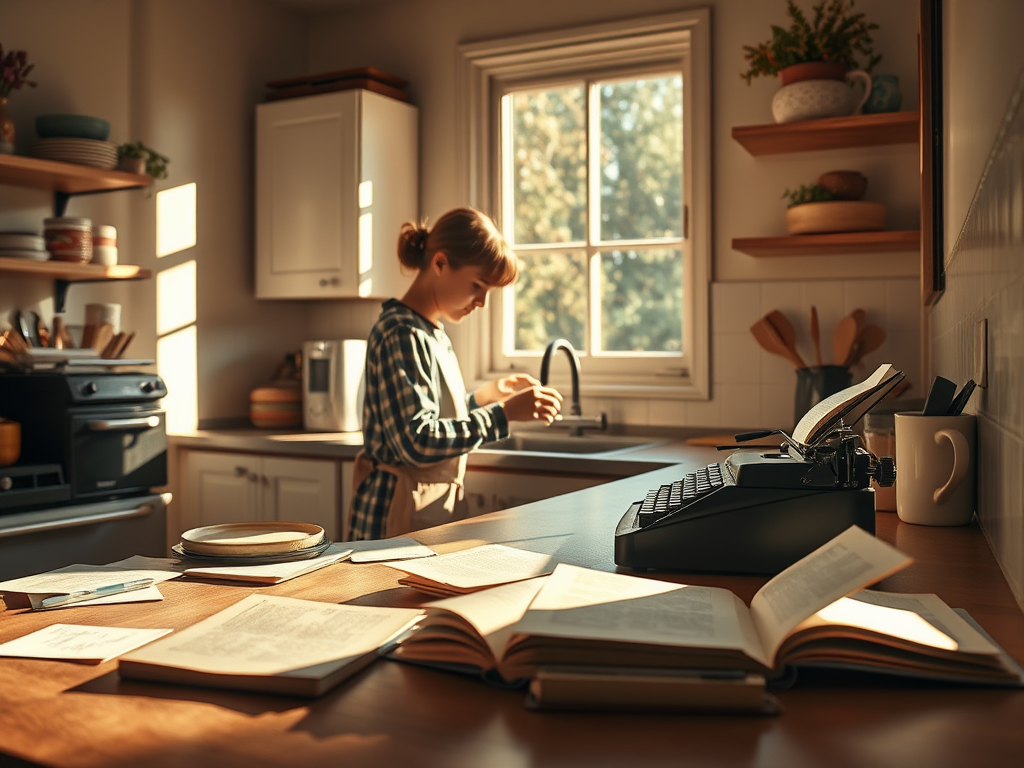
“The best time for planning a book is while you’re doing the dishes”.
— Agatha Christie
Dear Readers,
In late September 2025, I was driving home from work, when a deer hit the side of my car. I swerved to the right, which put me in line for a direct collision with the nearest tree. Luckily, I then swerved to the left, narrowly missing the tree and stopping just in time to not hit the next one or the 45 mph speed limit sign to my left. I called 911 and police arrived. Once the cop wrote up the incident, I got the insurance straightened out and waited for a tow, it was nearly midnight. Over the next couple days, I waited for them to tow the car to the body shop, which they did. It stayed there for about a month under repair before I got my vehicle back. The total repair bill was north of $3,000, but my insurance had covered most of it. The final deductible was only $100, and the car looked good as new. I was never more relieved to get my car back. Oh deer!
But, about that time, my life also got extremely busy. I began to feel very overwhelmed as October set in and the holiday season loomed. Part of the problem was that I had an order for my side-hustle, Midnight Quilting and Crafts, that was due by Christmas. My uncle had ordered three handmade crocheted hats in different colored yarn. And, as my mom reminded me, I had better get them done by Christmas if I wanted my reputation as an artist preserved (and, by implication, as a member of the family as well). So, I put everything down and got busy. That busy ended up lasting me until about Christmas.
And, my writing? Well, that got put aside too. I had been working on some poetry in September. While my work on my book certainly continued and was addicting at times, the work on this website temporarily stalled. I was, by definition, distracted by other things.
In the end, I don’t think this was an entirely bad thing. I finished the project I was working on for my uncle, who loved it. I also crocheted some mug cozies for my Christmas gift this year, and those turned out well. I helped put on the Christmas party for Ladies Night Out (LNO) with our pastor’s wife and the LNO committee and got to show off my photography skills and my creativity. I got the car back in one piece. And, I developed a deeper storyline for my book, which also needed to happen. That short break also allowed me to develop two new poems in December, poems that had been sitting around, that I hadn’t done anything with on the website for quite some time.
During that time, though, I don’t think I stopped writing — not really. I feel like I kept writing in the back of my head, especially when I was sitting guarding at the pool. Scanning, like driving or showering, is sometimes a good time to think. Really, though, thinking about things never really stops, especially in those moments where your hands are busy and your head is not. And, in those moments, my head would drift to what I was working on, be it that crochet project or my writing or whatever. I have to tell you, it generated some of the best ideas maybe I wouldn’t have thought of otherwise. Or, sometimes, an idea would spark from a show I was watching or a book I was working reading. “You know, I could make my character do that..” “I could write a poem about that..”
Or, as Agatha Christie put it:
“The best time for planning a book is while you’re doing the dishes”.
But, hold on! All this isn’t writing, you say. How can it be productive?
I think, oftentimes we frame distraction from writing as negative. I had to look up quotes for this Ad-Lib and all the ones about distraction from writing were about not getting distracted. For example, this quote written by an anonymous source:
“Being a good writer is 3% talent, 97% not being distracted by the Internet.”
Okay, that’s funny. But, what if, in getting distracted by the Internet, you stumbled on something that was actually helpful to what you were writing about? In that case, wouldn’t distractions sometimes be a good thing, fuel to the fire? Even if it was unhelpful, you would know to eliminate it?
I mean, don’t get me wrong. Focus is important. Attention to our work is important. But, I think there’s also such a thing as being too narrowly focused. If we fail to let things distract us, therefore, I propose we might end up with something less interesting and not attuned to the nuances of daily life. So, we have to take these breaks, allow ourselves to get distracted. It’s probably not only good for our mental health but also for the writing we are doing itself.
I like how this little blurb from The Writer’s Bureau puts it:
“Distractions can be a great way to find inspiration for your writing. Rather than always trying to shut out the world around you, try to pay attention to it. Use the things that distract you as a source of inspiration. For example, if you’re distracted by people-watching, use that as inspiration for your characters. Or, if you’re distracted by the sound of rain outside your window, use that as inspiration for a scene in your story.
Sometimes, distractions are exactly what we need to regain focus. If you’re struggling to focus, try setting up a distraction for yourself. For example, you could listen to white noise or rain sounds while you write. This can help create a soothing environment that allows you to focus and be more productive. Additionally, consider creating a physical distraction for yourself. Set up a small, tactile activity nearby, such as a fidget spinner or a Rubik’s Cube, that you can play with during short breaks. Keeping your hands busy can leave your mind free to think about your writing.
Burnout is a common issue with writers. Whether you’re struggling to fix plot holes or to create realistic characters, getting stuck happens to all of us. The best way to avoid this is to make sure you are taking regular breaks. Distractions can work in your favor, so don’t feel guilty if they temporarily lead you away from your writing.
Distractions don’t have to be a hindrance to your writing process. In fact, when used correctly, they can be a beneficial tool. Whether you use them to inspire you, take breaks, or create a soothing environment, distractions can help you write more efficiently and effectively. So, the next time you find yourself getting distracted, don’t fight it – use it to your benefit.”
According to The New York Times Magazine, Writer Laura Hillenbrand, who wrote “Seabiscuit: An American Legend” and “Unbroken: A World War II Story of Survival, Resilience, and Redemption”, has a unique illness that confines her to her home. As a result, she has had to get creative with her research methods for her writing. For instance, she can’t look at microfilm.
Instead, Hillenbrand buys vintage newspapers on eBay and reads them in her living room, as if browsing the morning paper. The first time she tried this, she bought a copy of The New York Times from the week of Aug. 16, 1936. That was the day Seabiscuit’s team — his owner, Charles Howard; his trainer, Tom Smith; and his jockey, Red Pollard — first collaborated at the Detroit Fair Grounds. Hillenbrand told me that when the newspaper arrived, she found herself engrossed in the trivia of the period — the classified ads, the gossip page, the size and tone of headlines. Because she was not hunched over a microfilm viewer in the shimmering fluorescent basement of a research library, she was free to let her eye linger on obscure details.
“There was so much to find,” she said of her reading. “The number-one book was ‘Gone With the Wind,’ the Hindenburg flew over Manhattan with a swastika on it and Roosevelt made a speech saying America would never become involved in foreign wars.” Soon she bought another newspaper, and then another. “I wanted to start to feel like I was living in the ’30s,” she said. That elemental sense of daily life seeps into the book in ways too subtle and myriad to count.
‘He became a 17-year-old runner for me, or a 26-year-old bombardier. I wasn’t looking at an old man.’
It was in those vintage newspapers that Hillenbrand discovered her next book. “I happened to turn over a clipping about Seabiscuit,” she said. “On the other side of that page, directly the opposite side of the page, was an article on Louie Zamperini, this running phenom.” Hillenbrand had no idea what became of Zamperini in the years to come, as the war broke out and young men gathered on Hamilton Field near San Francisco to fly B-24 bombers across the Pacific, but something about the young runner caught her attention. Maybe it was the mischievous look in his eye or the way he tipped forward when he ran, as if falling toward the finish line. Maybe it was the way, as she would later write, “his ears leaned sidelong off his head like holstered pistols, and above them waved a calamity of black hair.” Whatever it was, Hillenbrand jotted Zamperini’s name in her research notebook on Seabiscuit and promised herself, “I’ve got to find this guy when I’m done.”
— Wil S. Hylton, “The Unbreakable Laura Hillenbrand”, an article published in New York Times Magazine
This was how Hillenbrand found her next novel: by stumbling upon it in a newspaper when she wasn’t looking for it. She was looking for information for “Seabiscuit”, but she found “Unbroken” instead. Had she not opened her up to all those obscure details and distractions of the newspaper, perhaps we would not have her second novel. So, in this case, Hillenbrand’s moment of distraction was incredibly productive.
In her article, “Can Your Distractions Make You a Better Writer?”, Charity Singleton Craig suggests distractions can actually benefit you when it comes to writing, using this instance as an example of how distractions can generate new ideas. She also further suggests distractions can alleviate writers block and refresh inspiration. She talks about how the culture is so fixated on being attentive that it tends to miss everything else.
“So instead of worrying about how distracted we’ve become, what if instead we focus on becoming distracted by better things? What if there’s actually some good that comes from allowing our attention to jump to the train whistle or the birdsong instead of our work? Or from occasionally getting up from the desk to take a walk or from continuing to read when really we meant to finish just a chapter? “In the best of scenarios, the inability to filter out environmental distractions can lead to creative breakthroughs, something known as opportunistic assimilation,” Dahl and Ruddy write. “Instead of ignoring whatever has popped up that doesn’t immediately seem to be relevant to your work, what if you could use it instead?””
Yeah, what if you could use it instead? Or, just keep it percolating there for later? What about that? I think that is how we make our distractions productive, by allowing them to enrich the writing we are actually doing. I think that’s what I’m saying here.
Before that September crash, I had never hit a deer before, thankfully. I had heard about other people hitting deer and I felt sorry for them. But, it wasn’t until I had that dent in my car door that I completely understood. I have often said that life experiences are the key to writing. You know what? If I ever write about someone hitting a deer, I think I will be able to express it better now. Actually, any of the things I have mentioned I can articulate better now that I have lived them. So yeah, I got distracted for a bit. But heck, I learned a lot in the process; and, that’s going to make me a better writer the next time I sit down at the computer. In the past, I used to get really apologetic about getting distracted. Now, I think, I don’t have to.
Think about that.~
Sincerely, Your Author,
Jessica A. McLean
…………………………………………………………………………………………………………………………………………..
Recent Happenings:
- Recent Ad-Lib Activity:
- February 2026 Ad Lib is here
- TBA: I’m working on finishing my series on form. Stay tuned.
- February 2026 Ad Lib is here
- Recently Published:
- Poems Added:
- Villanelle, “Rubbing my mother’s feet”
- Reverse etheree, “Political violence”
- Poems Added:
- Editing, editing, and more editing.
- Waiting
……………………………………………………………………………………………………..



 The Rose